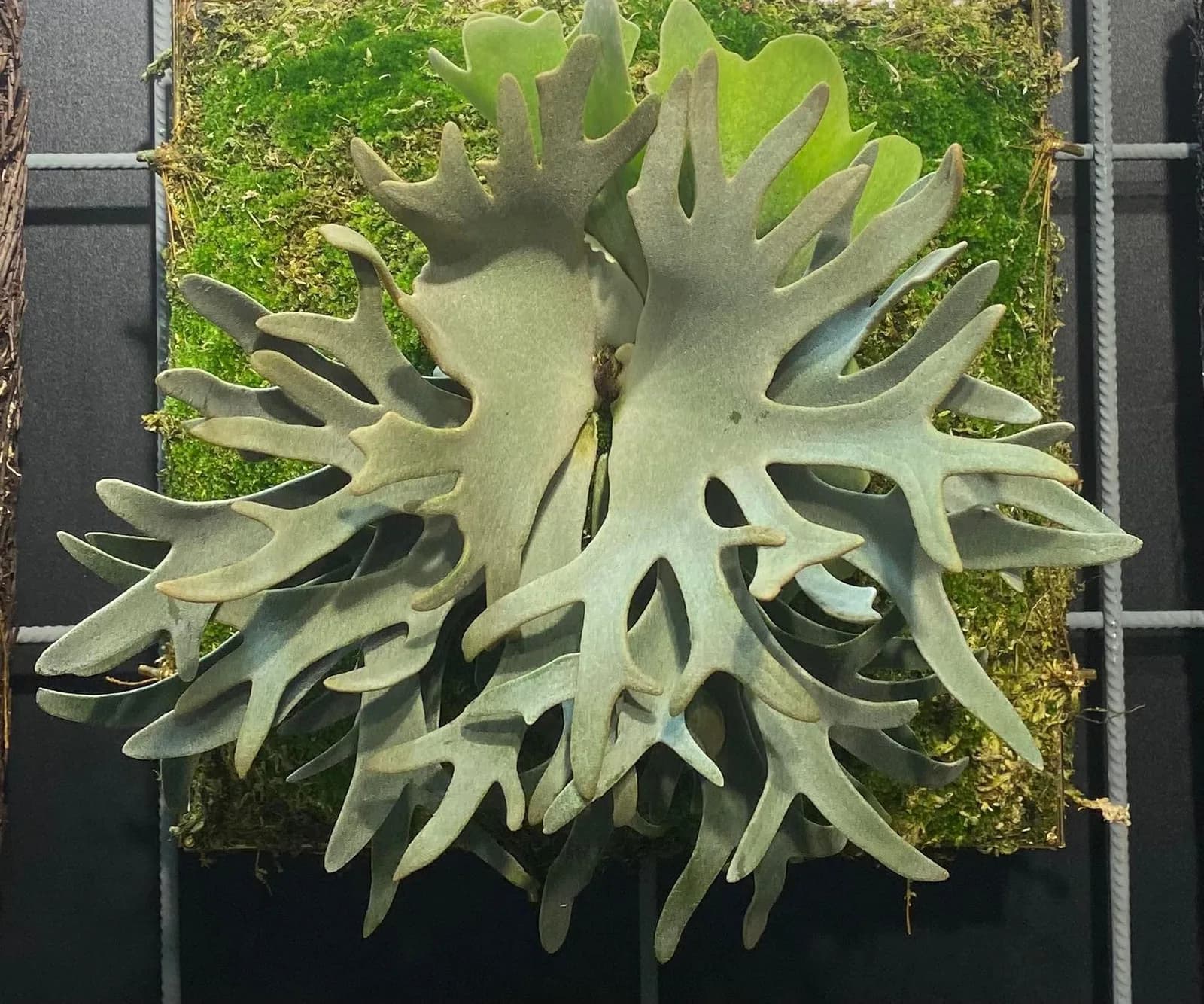
Cultivar
Platycerium willinckii 'OMG'
OMG
- Latin
- Platycerium willinckii 'OMG'
- Chinese
- OMG
- Japanese
- OMG
- English
- OMG
Parent species
Platycerium willinckiiJava staghorn fern
One of the dwarf selections of Platycerium willinckii: short, broad, repeatedly forked fronds, from the same batch as Jade Girl, Golden Boy and Nano. A trade name, not a registered cultivar. How to recognise it, how a true dwarf differs from a false one, and what to ask before buying.
Care notes
What the name refers to
OMG is one of the dwarf selections of Platycerium willinckii, from the same batch as Jade Girl, Golden Boy and Nano. It is a trade name, not a registered cultivar, with no registration document to check against. Taiwanese collectors count it among the "six legends".
How to recognise it
- Short, broad, repeatedly forked fronds. PlatyWiki describes OMG as short and wide with many divisions, and calls it one of the more advanced dwarfs.
- Thick silver-grey. The mature plant photographed in Taipei at the top of this page shows that heavy silvered tone.
- Small. Dwarf willinckii typically mature at 15–30 cm, a third to a fifth of an ordinary plant.
True dwarfs and false ones
This is the thing to understand before buying any dwarf willinckii. According to the selector, Huang Yuan, writing on Facebook, Indonesian collecting areas were later combed for wild plants that merely looked dwarf — and almost all turned out to be false dwarfs, growing back to normal size once conditions improved. A true dwarf is a genetic growth defect and appears very rarely.
So you judge a dwarf by origin and mature form, not by how small it looks today. Every juvenile looks small.
How care differs from the species
The Platycerium willinckii principles still apply, but dwarfs have their own temperament:
- Slow. The growth defect makes it slow. That is not your fault.
- Cooler suits it. Collectors generally use a cool room with grow lights. In unsuitable conditions it simply stalls — neither growing nor dying.
- Pups take years. A pup carrying the same dwarf traits usually means waiting two to three years.
- Less water. A small plant in little medium stays wet longer.
Three questions before you buy
- How was it propagated? Mass-produced sporelings can revert to an ordinary willinckii.
- Can you see a mature plant? Dwarfism only counts once the plant is grown.
- Has the name travelled with the plant? The same plant does get renamed between markets.
Where the name came from
PlatyWiki cites a Facebook post by the selector, Huang Yuan: in 2016–2017 he had contacts search Indonesian collector circles and four dwarf willinckii were found — later named Golden Boy, Jade Girl, OMG and Nano, none of which had individual names at the time. The entry itself notes that this account is repeated from the internet and unverified, and we pass it on the same way.
FAQ
How do I tell OMG from Jade Girl?
Look at the width of the fronds. OMG is short and broad with many divisions and a solid overall mass; Jade Girl runs to fine tips under a heavy silver coat. They came from the same batch and are nearly indistinguishable as juveniles, so judge mature plants.
What is a false dwarf?
A willinckii that looks stunted while young and grows back to full size once conditions improve. According to the selector, nearly all the wild-collected "dwarfs" that later flooded out of Indonesia were this. A true dwarf carries a genetic growth defect and stays small. Judge by origin and mature form, not current size.
Will an OMG sporeling stay dwarf?
Not necessarily. Mass-produced sporelings can revert to the size and shape of an ordinary willinckii. For the same individual you need a pup, but a pup carrying the dwarf traits usually takes two to three years to become available.
Why does my OMG seem to have stopped growing entirely?
Dwarfs are slow by nature, but a complete stall usually means the conditions do not suit it. Collectors lower the temperature and keep light steady; in a Taiwanese summer, ventilation and cooling matter most. A stalled plant will not die quickly, but it will not grow either — check temperature and watering first.
Other cultivars of the same species
Names selected from the same wild species, usually compared side by side.