Platycerium
Platycerium madagascariense
Madagascar staghorn fern
- Latin
- Platycerium madagascariense
- Chinese
- 非洲猴腦鹿角蕨
- Japanese
- マダガスカリエンセ
- English
- Madagascar staghorn fern
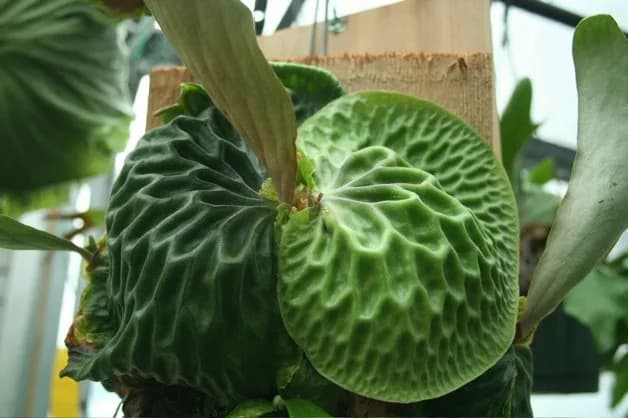
Platycerium madagascariense, the Madagascar or waffle staghorn fern, is easy to tell by its shields: round, flat to the mount and covered in a raised honeycomb of veins, vivid green when active, with short fertile fronds spreading outward. The smallest species in the genus, from humid forest in eastern Madagascar, it pups readily but demands constant humidity, moving air and mild temperatures.
Care notes
How to recognise it
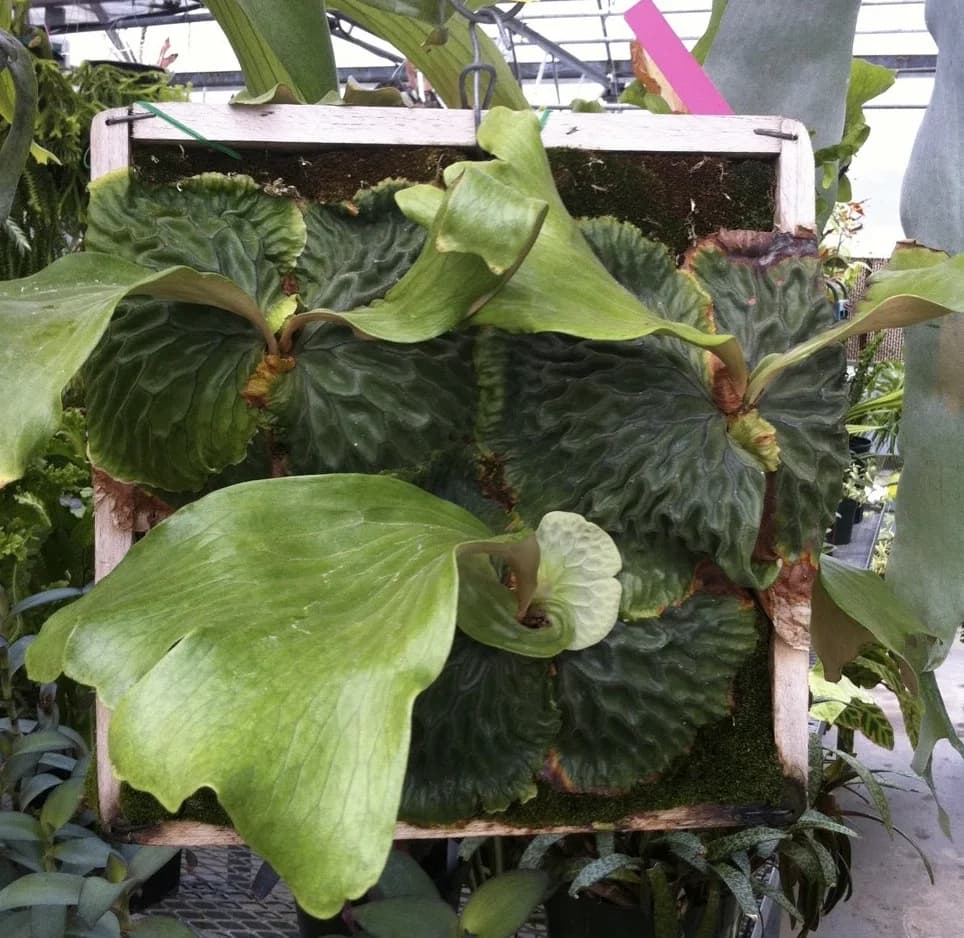
- Honeycomb shields: round and flat to the mount, with veins raised into a grid of cells, hence the name waffle fern; new shields are vivid green and age to brown.
- Small: the smallest species in the genus, with short fertile fronds that spread outward.
- It pups: mature plants often form a clump.
- Telling it from ridleyi: both are called "monkey brain" in Taiwan, so the names are easily confused. P. ridleyi closes its shields into a ball, holds forked fertile fronds upright and never pups; madagascariense keeps flat, round shields and short fertile fronds, and grows into a clump.
Native habitat
Platycerium madagascariense grows on trunks in the humid evergreen forest of eastern Madagascar, in the shaded, mist-fed middle storey rather than the bright canopy. The climate is even, wet and mild. That single fact separates its care from every other collector species.
Light
Moderate filtered light. It is more shade-tolerant than most of the genus, and direct sun bleaches and scorches the shields. An east window, or 50–70% shade in a greenhouse, suits it. Too much light causes more trouble than too little.
Water and humidity
The whole game. Keep the medium slightly moist at all times; once it dries out the shields pucker and the growing point stalls. Aim for humidity above 70% with constant gentle air movement. A sealed terrarium without a fan is a common way to lose it to rot; high humidity plus airflow is the formula. Soft or rain water is preferable.
Medium and mounting
Sphagnum that holds moisture without becoming waterlogged. A small tree-fern or cork board is ideal. Short rhizomes push pups sideways and the plant slowly forms a colony, so leave lateral room. Once settled, leave it alone.
Temperature and seasons (temperate, indoor)
Ideal range 18–28 °C. It resents heat above 30 °C, particularly with still air, and stalls or rots; it also dislikes cold below 12 °C. In temperate homes it is a year-round indoor plant, often happiest in a fan-cooled grow cabinet or a humid room away from radiators. Summer heatwaves are the danger period, not winter.
Common problems
- Shields turning brown: normal ageing, but browning new shields means the environment is wrong.
- Faint waffle pattern: low light or humidity, or simply a juvenile plant.
- Sudden crown rot in summer: heat and stagnant air, the most common cause of death.
- Scale and spider mite: appear when airflow is poor.
Collector notes
Frond expression. Roundness of the shield, depth and regularity of the honeycomb, freshness of the green phase, and the forking and spread of the fertile fronds. The hybrid 'Durval Nunes' (generally given as × P. stemaria) keeps part of the waffle texture while tolerating far more heat, and is a sensible compromise in warm climates.
Mother plant. Look for a healthy colony, a deeply and cleanly patterned shield, and evidence of new fronds year after year.
Propagation. Unlike P. ridleyi, P. madagascariense pups readily and can be divided, which preserves a mother plant's pattern exactly. Spore culture is possible but seedlings are extremely intolerant of drying. Tissue-cultured plants exist in trade. It does not forgive a dry weekend.
Images
FAQ
Why is Platycerium madagascariense considered the hardest species?
Because it wants everything at once: constant moisture, moving air, no heat above 30 °C, no cold below 12 °C, and never a dry spell. Miss one and it stalls or rots. It is not mysterious, just unforgiving. A fan, a humidifier and summer cooling make it steady.
How do I get Platycerium madagascariense through a heatwave?
Heat with still air is the main killer. Move it to the coolest bright room, run a fan around the clock, shade it heavily, keep the sphagnum evenly damp and check the crown daily. A fan-cooled grow cabinet or an air-conditioned room is the safest option during hot spells.
Does Platycerium madagascariense produce pups?
Yes, freely; this is its biggest difference from ridleyi. Short rhizomes push pups sideways and the plant gradually forms a colony. Once a pup has its own shield it can be separated, and the division carries the mother plant's waffle pattern exactly.
Is Platycerium madagascariense suitable for beginners?
Not as a first plant. It needs controlled humidity, airflow and temperature all year. If you want the waffle texture with less risk, start with the hybrid 'Durval Nunes', which tolerates far more heat, or grow ridleyi or coronarium confidently first and then take this one on.
How much light does Platycerium madagascariense need?
Moderate, filtered light only; it is an understorey plant. Direct sun bleaches and scorches the shields. An east-facing window or 50–70% shade in a greenhouse is right. If the waffle pattern looks faint, check humidity first before adding light.
Related species
Species often compared with, or mistaken for, this one.