Platycerium
Platycerium ridleyi
Ridley's staghorn fern
- Latin
- Platycerium ridleyi
- Chinese
- 亞猴鹿角蕨
- Japanese
- リドレイ
- English
- Ridley's staghorn fern
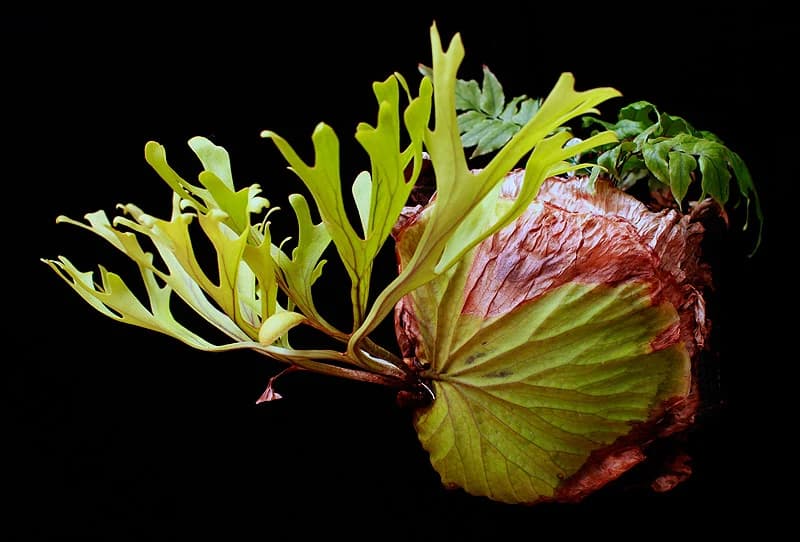
Platycerium ridleyi is unmistakable: its ribbed shield fronds close into a ball around the mount, and its upright, forked fertile fronds carry spores on separate spoon-shaped lobes. A canopy epiphyte of Peninsular Malaysia, Sumatra and Borneo, it never pups, needs bright light with moving air, and is the most sought-after species among collectors.
Care notes
How to recognise it
- The ball: ribbed shield fronds close into a ball that hugs the trunk or board.
- Upright fertile fronds: they rise or angle outward and fork repeatedly, like antlers.
- Spoon-shaped spore lobes: spores sit on separate spoon-shaped lobes, not on the underside of the frond tips.
- No pups: one plant stays one plant; it reproduces only by spore.
- Telling it from madagascariense and coronarium: P. madagascariense keeps small, flat, honeycombed shields and pups; P. coronarium raises an upright crown and lets long fertile fronds hang.
Native habitat
Platycerium ridleyi grows high in the canopy of lowland dipterocarp forest across Peninsular Malaysia, southern Thailand, Sumatra and Borneo. It sits in bright light with constant air movement, and its closed, ball-shaped shield fronds are often colonised by ants. That habitat explains almost every care rule below: light, air, and never a wet crown.
Light
Bright, filtered light is the baseline; gentle morning sun is welcome. Too little light and the fertile fronds stretch, droop and lose their silver sheen. Too much midday sun scorches them, especially behind window glass. A south or east window with a sheer curtain, or a grow light 30–40 cm away, works indoors.
Water and humidity
This is where most ridleyi are lost. Let the mount dry most of the way through before soaking, then let it dry again quickly. Aim for 60–80% humidity, but only with moving air: a small fan matters more than misting. Water that sits in the centre of the shield ball rots the growing point.
Medium and mounting
Use less sphagnum than you would for P. bifurcatum, and open it up with bark or tree-fern fibre so the fine roots breathe. Mount on a slatted or tree-fern board rather than a solid plank, and tilt the crown slightly forward so water drains away from it. Since there are no pups to divide, a ridleyi is mounted once and left alone; do not remount a settled plant unless the medium has collapsed. A shield frond that floats above the moss without touching it right after mounting is normal too — the roots simply have not gripped the medium yet — and pressing it down by hand risks snapping the brittle crown. If it needs help, add another layer of sphagnum around the outside, built up to the rim of the shield to bury the growing point a little deeper so the frond has something to rest against; keep that layer loose and mixed with bark, and let any tie hold the medium, never the frond. Whether to bring the moss up over the shield depends on how secure the plant is: if a gentle push does not move it, there is no need, because ridleyi hates stagnant air and the more medium you pack around it, the worse the airflow. Only build it up if it wobbles. Covering an old shield does no real harm; the next shield grows up over it from the outside.
Temperature and seasons (temperate, indoor)
Keep it between 20 and 30 °C. In a temperate home, ridleyi is a year-round indoor plant. In winter move it away from cold glass, hold it above 15 °C, and reduce watering while light is low, but do not reduce the light. Central heating dries the air; compensate with a humidifier and a fan, never with a wetter mount.
Common problems
- Brown edges on the shield: normal ageing. A soft, black, spreading patch is rot.
- Drooping fertile fronds: check light first, then water.
- Scale insects hide under the shield rim; remove by hand and improve airflow.
- Sudden collapse after a cold night: cold damage, usually irreversible.
Collector notes
Frond expression. Growers distinguish narrow-leaf, wide-leaf, round-leaf, dwarf silver, dwarf dense and 'Monkey King' (lacy-edged) forms, plus the Thai coral form sold as 'Pakarang'. These are selections within one species, not separate taxa, and the names are trade names rather than registered cultivars.
Mother plant. Judge a specimen by a full, symmetrical shield ball, evenly forked fertile fronds and thick stellate hair.
Propagation. Ridleyi does not produce pups. Every plant comes from spores or tissue culture, so provenance matters. A spore-grown plant from a documented mother plant carries the parents' expression with natural variation; tissue-cultured stock is uniform. Ask which one you are buying.
FAQ
How is Platycerium ridleyi different from P. madagascariense?
Ridleyi comes from Southeast Asia, closes its ribbed shields into a ball, holds its fertile fronds upright and never pups. Madagascariense is a small Madagascan species with flat, waffle-veined shields and short spreading fertile fronds, and it pups freely. Both want humidity with airflow; madagascariense dislikes heat more.
Why is my Platycerium ridleyi rotting, and how much humidity does it need?
Almost always water sitting in the crown or a mount that never dries. Ridleyi wants 60–80% humidity paired with constant air movement, a lean sphagnum mix, and a full dry-down between soakings. Add a fan before you add a humidifier, and keep it above 15 °C.
Does Platycerium ridleyi produce pups?
No. Ridleyi grows as a single crown and never offsets, so it cannot be divided. Every plant on the market is either spore-grown or tissue-cultured. Spore-grown plants vary and carry their parents' traits; tissue-cultured plants are uniform copies. A good seller tells you which.
How cold can Platycerium ridleyi tolerate?
Treat 15 °C as the floor. Below 10 °C the growing point is damaged, and the loss often shows only weeks later as a soft, dark crown. In temperate climates keep it indoors year-round, away from cold glass, with reduced watering but full light through winter.
What is the difference between dwarf and regular Platycerium ridleyi?
Dwarf ridleyi is a compact selection within the same species: a smaller shield ball, shorter and denser fertile fronds, usually heavier silver hair. It suits indoor shelves and grow lights. It costs more because dwarf traits are not fixed in spore batches and take years to confirm.
The shield frond on my mounted Platycerium ridleyi floats above the moss instead of lying flat. What should I do?
This is normal right after mounting — the roots have not gripped the medium yet. Do not press the shield down by hand; the brittle tissue near the crown snaps easily. Add another layer of sphagnum around the outside, built up to the rim of the shield to bury the growing point a little deeper, so the frond has medium to rest against as new roots pull it in. A plastic-wrap technique used for other species can work here too, but keep it shorter and ventilated. If unsure, have an experienced grower remount it.
Related species
Species often compared with, or mistaken for, this one.
Currently available
Plants of this species you can take home now.