Platycerium
Platycerium coronarium
crown staghorn fern
- Latin
- Platycerium coronarium
- Chinese
- 皇冠鹿角蕨
- Japanese
- コロナリウム
- English
- crown staghorn fern
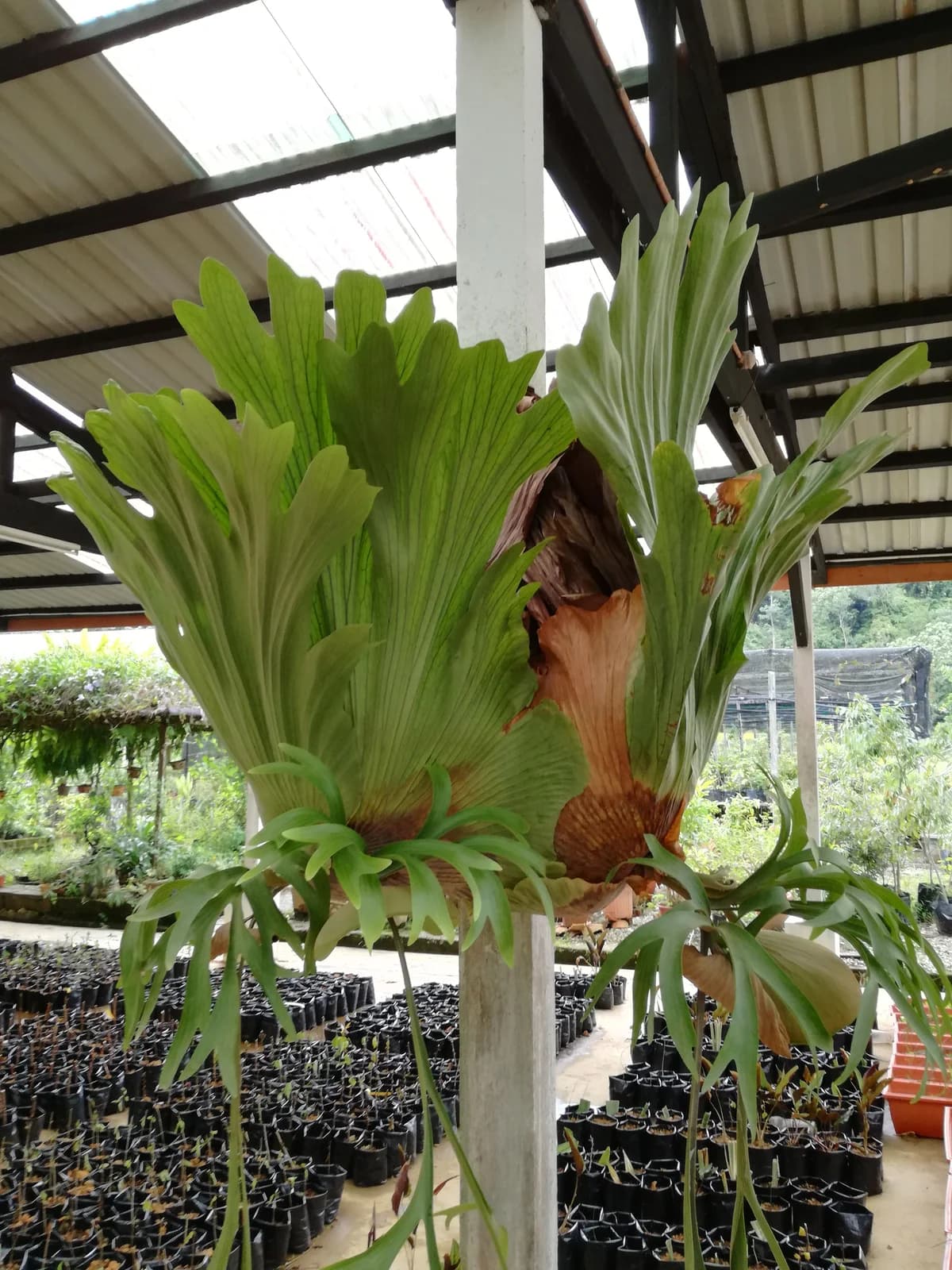
Platycerium coronarium, the crown staghorn fern, is easy to recognise: tall upright shield fronds split into a crown, and fertile fronds hang from the top one to two metres or more, with spores on a separate kidney-shaped lobe. A lowland epiphyte of Southeast Asia, it pups, tolerates more than ridleyi, and needs room to hang.
Care notes
How to recognise it
- The crown: tall, upright shield fronds split at the top into a ring of lobes, which gives the species its name; they stand like a tube and catch water themselves.
- Long, hanging fertile fronds: they fall from the top of the crown, commonly one to two metres on a mature plant, forking repeatedly into strap-like segments.
- A separate spore lobe: spores are not carried on the underside of the frond tips but on a kidney-shaped lobe that grows out of the fertile frond; on immature plants its shape is irregular.
- Telling it from ridleyi: P. ridleyi wraps its shields into a ball and holds stiffer fertile fronds up or out; coronarium raises an upright crown and lets long fronds hang.
Native habitat
Platycerium coronarium grows on large trees in lowland rainforest and monsoon forest from Thailand and Peninsular Malaysia through Singapore, Sumatra and Borneo to the Philippines. The upright shield fronds collect falling leaf litter, and the fertile fronds hang from the crown like ribbons. In Singapore and Malaysia it is a native plant seen on roadside trees.
Light
Bright, filtered light. It tolerates slightly less light than P. ridleyi, but in a dim room the shields stay short and the fertile fronds turn thin and green. Morning sun is fine; avoid midday sun behind glass.
Water and humidity
The upright shields form a funnel that catches water, so this species forgives more than P. ridleyi. Soak when the surface of the medium is dry. Growth is fastest above 60% humidity; below 50% the frond tips brown. Keep air moving and never let water stand at the bottom of the funnel for days.
Medium and mounting
Sphagnum with a little bark. This is a tall, heavy plant: choose a thick board with a secure hanger, and leave at least a metre of clear space below it for the fertile fronds. Pups can be separated once they have their own shield, or left in place to form a clump.
Temperature and seasons (temperate, indoor)
Ideal range 22–32 °C; it enjoys heat. In temperate homes it lives indoors year-round. Keep it above 12 °C in winter; below 10 °C the fertile fronds blacken. Reduce watering in low light and keep a fan running so the funnel does not stay wet.
Common problems
- Black frond tips: low humidity or fertiliser burn.
- Sour smell from the funnel: standing water and rot; tip it out and improve drainage.
- Only shields, no fertile fronds: too little light or nutrition; fertile fronds appear reliably on mature plants.
- New fronds smaller than old ones: roots have filled the board or the medium has broken down.
- An immature plant's spore lobe looks odd, multi-fingered or half-round: mature plants carry a complete oval spore lobe; immature ones show a transitional shape. Not a variation, not a growing problem — judge it on a mature plant.
Collector notes
Frond expression. Trade distinguishes the common form from the Philippine form (deeper-cut crown, broader and shorter fertile fronds) and various dwarf and thin-frond selections. None of these is a formally described variety. Judge by the number of forks, the length of the drop and the width of the fertile fronds.
Mother plant. Look for a complete, symmetrical crown, fertile fronds emerging evenly from the top, and, in clumps, heads of similar size.
Propagation. Coronarium pups, so divisions preserve a mother plant's expression exactly. Spore-grown plants vary and are the route to new forms; tissue-cultured plants are uniform. A staghorn fern this large deserves a documented origin.
FAQ
How long do Platycerium coronarium fertile fronds get, and how much space do I need?
Mature plants commonly hang fertile fronds one to two metres, and wild plants are recorded longer. Leave at least a metre of clear space below the board so the tips do not fold on the floor, and use a hanger rated for a heavy, growing plant.
Does Platycerium coronarium produce pups?
Yes. Mature plants push new crowns beside the shield fronds. You can separate a pup once it has its own shield, or leave it to build a multi-headed clump. Divisions carry the mother plant's expression exactly, which spore-grown plants do not.
What is the Philippine form of Platycerium coronarium?
A trade name for plants of Philippine origin with a more deeply cut crown and broader, shorter fertile fronds, giving a more compact look. It is not a formally described variety. Judge the actual fronds rather than the label, since names drift between sellers.
Is Platycerium coronarium easier than P. ridleyi?
Noticeably. Coronarium handles heat, catches its own water in the shield funnel, accepts a little less light and produces pups. Ridleyi rots when humid air stands still, hates cold and never pups. Coronarium is the safer first collector species, provided you have the vertical space.
How do I overwinter Platycerium coronarium indoors?
Keep it above 12 °C, away from cold windows, with as much light as you can give it. Water less often but do not let it dry hard, and keep a fan on so the shield funnel dries between soakings. Fertile fronds blacken below 10 °C.
Related species
Species often compared with, or mistaken for, this one.