Platycerium
Platycerium wandae
queen staghorn fern
- Latin
- Platycerium wandae
- Chinese
- 女王鹿角蕨
- Japanese
- ワンダエ
- English
- queen staghorn fern
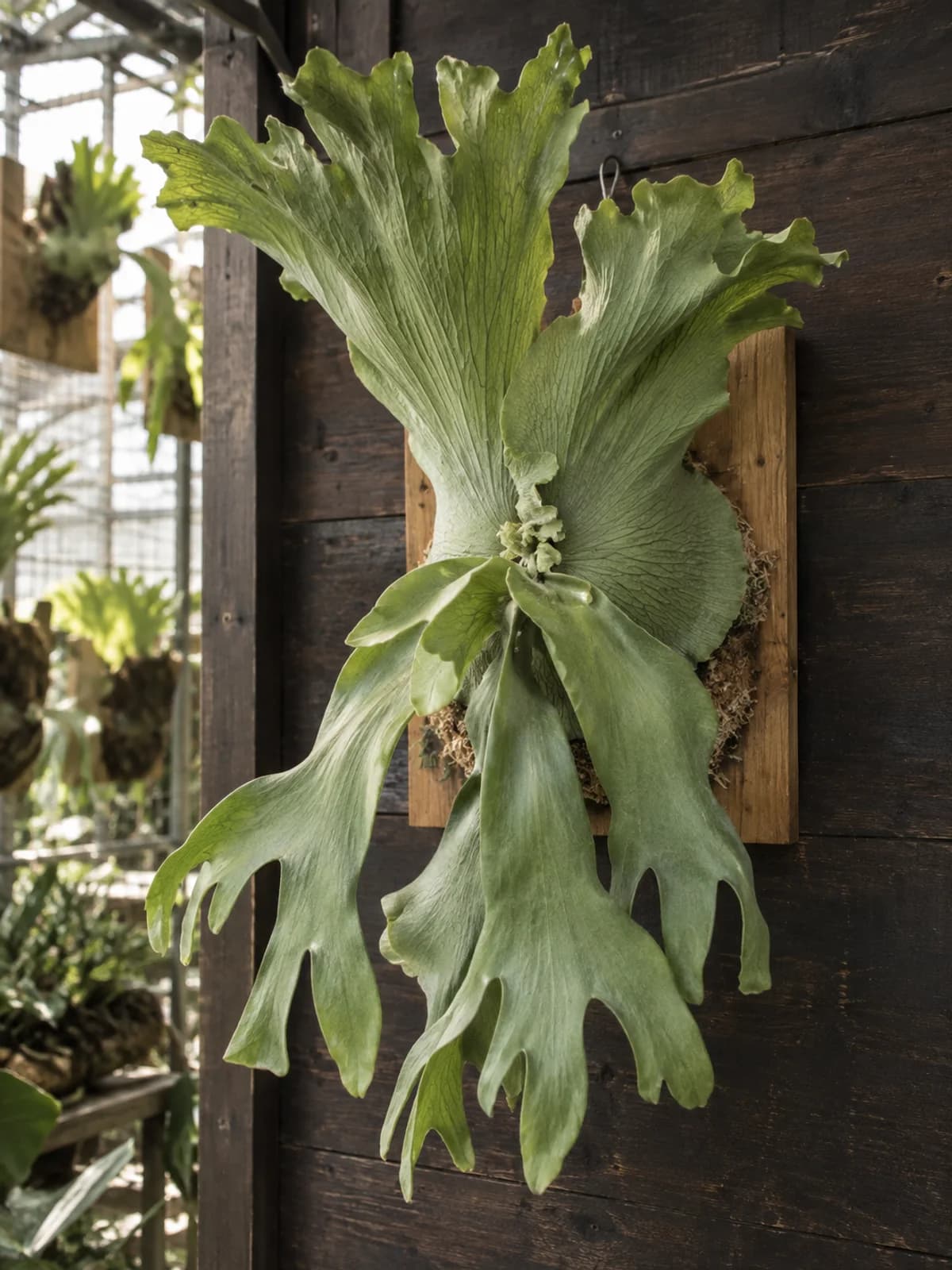
Platycerium wandae, the queen staghorn fern, has shield fronds that can span two metres with deeply cut tops, a distinctive frill of lacerated tissue around the bud, and fertile fronds in two unequal lobes, the long one broad and hanging. Native to lowland rainforest in New Guinea, it is the largest species in the genus. It never pups, so every plant is spore-grown, and mature specimens are collection centrepieces.
Care notes
How to recognise it
- A frill of lacerated tissue around the growing point: unique to wandae; neither grande nor holttumii has it, so it is the most reliable sign.
- Fertile fronds in two unequal lobes: the short one stands up and does not fork again; the long one is broad and hangs.
- Huge shields with deeply cut tops: up to two metres across on a mature plant, the lobes deep and even.
- Telling it from holttumii: in holttumii the erect lobe forks again, the veins are heavy, the fronds are thick and project forward, and the shields read whiter. Juveniles are nearly impossible to separate; only provenance tells.
- Two wandae that look different are not necessarily a mistake: plants sold as wandae include pure sporelings, tissue culture and hybrids with other large species, and sporelings from one batch vary anyway. Judge the structures, not the overall outline.
Native habitat
Platycerium wandae is an epiphyte of hot, humid lowland rainforest in New Guinea, with no marked dry season. It grows high on large trunks, where the huge shields trap leaf litter and the mature plant becomes a heavy, self-composting basket.
Light
Bright, filtered light. Young plants tolerate shade; adults need more light before they will produce fertile fronds. Avoid midday sun behind glass, since scorch on a shield leaves a permanent brown scar, but morning sun is welcome.
Water and humidity
It likes moisture but not stagnant air. Soak when the surface of the medium dries; mature shields hold water, so large plants need watering less often than small ones. Humidity of 60–80% is ideal; below 50% the shield edges crack and brown. Keep air moving. Most growers find the dwarf wandae wants the opposite: keep its sphagnum on the dry side, since staying wet invites blackening and rot.
Watering it once it gets big
By year three or four, plant and board together are too heavy to lift down, and taking it off to soak stops being an option. Most growers switch to a telescopic-pole watering wand and stand on the ground to reach the sphagnum, rather than mounting and unmounting the board — a shield frond or growing point damaged in handling can cost a whole season. A board that has just absorbed water is markedly heavier, which is hard on hooks and wall fixings too.
The technique is to water the sphagnum, not the fronds. Work slowly around the outer edge of the moss so the water has time to soak in; a hard jet mostly runs straight onto the floor, and it looks like a thorough watering when it was not. When it really needs a deep drink, water lightly several times in one day — the cumulative effect comes close to a soak.
A high position usually has better airflow, but still check that water is not sitting in the frond axils, especially on a still, humid summer night when that is exactly how blackening starts.
Medium and mounting
A generous sphagnum bed suits its vigorous roots. Start with a large, thick board, because a wandae cannot be remounted casually once its shields have wrapped the board. Plan the wall fixing for a plant that will weigh well over ten kilograms when wet.
When it outgrows the board, enlarge without removing it. Prying a big plant off its board damages the frond bases and the growing point. The safer route is to leave the old board in place and fix the whole thing, old board and all, onto a larger new board: longer screws and more fixing points, plus heavy nylon or stainless wire threaded through the middle of old shield fronds and tied back to the backing in three or four places, avoiding new fronds. For the medium packed around the outside, coir with a little sphagnum mixed in is less likely than pure sphagnum to leave the frond bases wet and blackening; soak the coir for about an hour and rinse it twice first.
Temperature and seasons (temperate, indoor)
Ideal range 22–32 °C. In temperate climates it is an indoor or conservatory plant year-round. Hold it above 12 °C; below 10 °C the shields and growing point are damaged. In winter reduce watering, keep the light as high as possible and run a fan. Central heating dries the air; a humidifier helps more than misting.
Common problems
- Cracked, dry shield edges: low humidity or sun scorch.
- No fertile fronds for years: normal; wandae must reach considerable size first.
- Dark brown patches along the lower edge of the shield: check the growing point first; if it is firm and still pushing new fronds, there is no rush. Patches that sit where water collects, along the lower edge and in gaps, with clear borders and a soft feel are water damage; browning that spreads inward from the edge, leaving the frond dry and papery, is an old frond ageing. Colour looks darker just after watering, so compare once the surface is dry. Lay the plant flat to dry and stop misting; do not peel the patch, new shields will cover it. Dark patches on the back can also be scale.
Collector notes
Frond expression. Depth and number of lobes at the top of the shield, how developed the frill around the bud is, and the width and forking of the fertile fronds. In Taiwan wandae is one of the most widely grown species, yet plants raised to a full, symmetrical crown remain uncommon.
Mother plant. Look for left-right symmetry of the shields, a clearly defined frill, and broad fertile fronds hanging evenly.
Propagation. Wandae never produces pups and cannot be divided; every plant is spore-grown or tissue-cultured. Sporelings look almost identical to P. grande and P. holttumii for years, and mislabelling is common, so buy from a grower who can point to the mother plant. It is a long game, and it rewards patience.
FAQ
How do I tell Platycerium wandae from P. grande and P. holttumii?
On mature plants look at the bud: wandae has a frill of lacerated tissue around the growing point that the other two lack. Grande carries two spore patches per fertile frond; holttumii has shorter shield lobes and thicker fertile fronds. Juveniles are near-identical, so provenance is the only guide.
Does Platycerium wandae produce pups?
No. Like grande, superbum and holttumii, wandae grows as a single crown and cannot be divided. Every plant in trade was raised from spores or tissue culture, which is why large specimens cost what they do: each one was grown from a sporeling over many years.
Is Platycerium wandae good for beginners?
Juveniles are easy, shade-tolerant and inexpensive, so it is often sold as a starter. The catch is size: it grows large and heavy, needs a big board and a strong wall fixing from the start, and takes years to produce fertile fronds. Good for a patient grower with room.
How big does Platycerium wandae get?
In the wild shield fronds can span two metres; in cultivation a metre across is typical for a mature plant, weighing well over ten kilograms when wet. It is the largest species in the genus, so check the wall fixing before you hang it.
How do I overwinter Platycerium wandae?
Keep it above 12 °C, ideally warmer, in the brightest spot you have. Below 10 °C the shields and bud are damaged. Water less, run a fan so the medium dries between soakings, and use a humidifier against central-heating air. Do not move a large plant more than necessary.
A lower fertile frond on my wandae is yellowing and drooping. Should I cut it off?
Usually it is just ageing: only an outer, lower, older fertile frond yellows from the bottom up and feels dry and brittle rather than soft, while new fronds and the growing point look fine. You can cut it at the base with clean scissors, keeping clear of the bud and the shield fronds beside it, or leave it until it has dried out completely. Blackening and softness at the base or centre, sometimes with a smell, points to water damage; scorched edges in one spot point to sunburn. Only if the whole plant, new fronds included, is yellowing should you go back over light, water and airflow. Keep the shield fronds however brown they get.
When remounting a wandae, should I pack the space behind the shield with sphagnum?
No need to pack it full. How thick to go depends on how you water: if four or five days or more pass between waterings, a thick layer behind the shield stays wet too long, and the join between shield and medium tends to rot black. Only if you water often and the air moves well does it need to be thicker. Wandae roots vigorously and its new shields spread over the board on their own, so they do not need filler to prop them up. If it really needs more support, use coarse coir chunks instead of pure moss: they drain fast and stay far less soggy. Keep the binding line on the medium, never tight across a frond.
My wandae's shield frond got knocked and creased. Should I cut it off?
No. A crease in a shield that has already unfurled will not heal, but it is not disease: the frond keeps growing, keeps wrapping the board and gathering medium, and has roots and the bud underneath it. While the frond is still soft, you can hold the creased part back to its original angle against the board with paper tape or cling film, and remove it once the frond has firmed up; do not wrap it tight, keep off the growing point, and do not stick anything to the tenderest edge. Then leave the board still for a few weeks and do not let water pool in the crease. Only if the damage turns dark brown, goes soft and keeps spreading is it water damage or infection, and then the fix is airflow and watering.
Related species
Species often compared with, or mistaken for, this one.