Published · Updated
How Often to Water a Staghorn Fern: Soaking, Misting, Reading the Shield Frond, and Adjusting by Season and Species
The first question every new grower asks is how many days between waterings. There is no such number. Three ways to read a mounted staghorn fern: lift the board, read the sphagnum, read the shield and fertile fronds. Why soaking, pouring and misting are not the same thing, and how to adjust through the seasons and across species from ridleyi to bifurcatum to wallichii.
First, the honest answer: there is no fixed number of days
The first question every new grower asks is how many days between waterings. There is no such number. The same Platycerium bifurcatum on a breezy balcony and in a closed, air-conditioned room will dry at speeds that differ by a factor of two or more. Most sources give roughly three to seven days in summer and ten or more in winter, but that is only a starting point; what is worth learning is the three tests below.
Test one: lift the board
A freshly soaked board is heavy; as the medium dries it becomes noticeably lighter. For the first few weeks, lift it once a day and memorise the two feelings, just soaked and ready for water. After that your hand does the work. If a plant hangs too high to reach, hang a small mount in the same spot as an indicator.
Test two: read the medium
The colour of the sphagnum is only a rough guide. A more reliable check is to press firmly with a fingertip: if it dents flat easily, it is still wet; if the surface feels dry but pressing releases moisture, it is dry outside and wet within; if it is dry through and gives a faint crackling sound, it is bone dry and ready for water. Once the shield fronds have wrapped the board, the core dries far more slowly than the surface, so a mature plant needs a longer interval than you expect.
Test three: read the shield and the fertile fronds
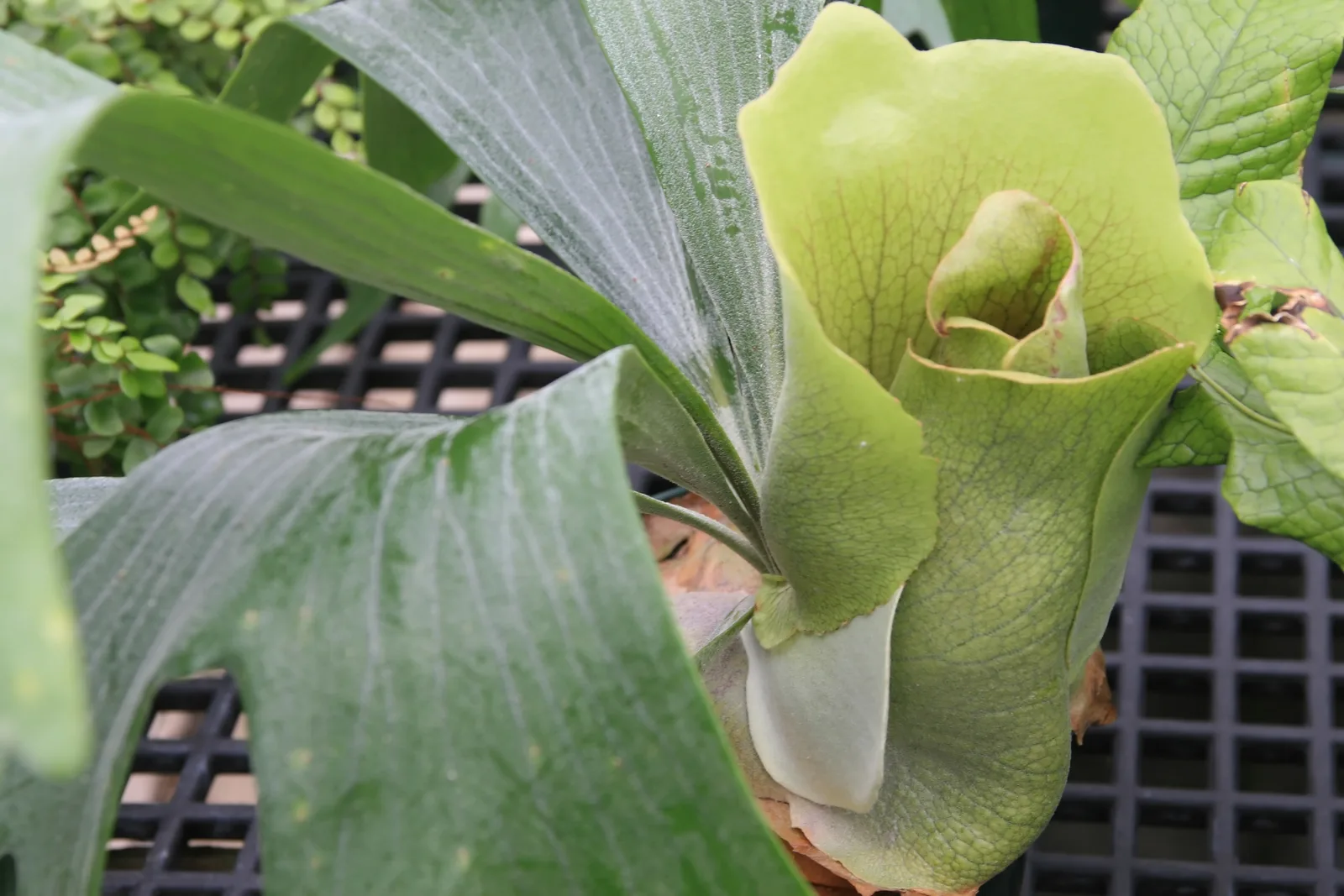
The shield frond is the plant's own reservoir. Healthy, it is full and springy; short of water it thins and the edges pucker first; chronically wet, it softens from the base. Fertile fronds droop when thirsty and most recover within a day or two of a soak. If they do not recover after a soak, and start to yellow, the problem is the roots, not the water.
How to water: soak first
For a mounted plant, soaking is the main method: submerge the board, and once the bubbles stop it has taken up all it can. Bone-dry sphagnum repels water, so pouring over the top rarely reaches the roots, and misting is not watering at all. For how to choose between the three, and what to do with a board too big to move, see soaking, pouring or misting.
Two schools of watering: little-and-often versus dry-then-soak
Watering frequency is ultimately decided by the environment and the mix, not by a fixed rule. Growers split roughly into two camps: little and often to keep the moss barely damp, or let it dry fully before soaking again; both raise healthy plants. If you cannot yet read your own conditions, start with the dry-then-soak approach and switch once you have the feel for it.
Adjusting through the seasons
The notes below follow Taiwan's climate, but the logic transfers to any home. In a heated temperate room the winter section matters most; in a humid tropical one, the rainy-season section does.
Plum rains (May to June). Humidity is high and the medium dries slowly, so intervals stretch on their own. If the board is still heavy, skip the day.
Summer (July to September). Water in the morning or evening, never in the afternoon heat; soaking a hot board is a warm bath for the roots. A well-ventilated spot may dry in two or three days; a hot, still spot should be watered less often, not more.
Autumn (October to November). Peak growth for most species: the medium dries fast and the plant is hungry. Do not hold back.
Winter (December to February). Roots take up little in the cold, and intervals of ten days or more are normal. Stop watering a day or two before a cold snap; see getting through winter. Water around midday, at the warmest point of the day. Central heating dries a room fast, so feel the medium before you stretch the interval.
Adjusting by species
Wet, then dry, sharply. P. ridleyi wants the medium most of the way dry before a soak, and then to dry again quickly; high humidity with still air rots the crown. P. coronarium and P. holttumii follow the same pattern with more forgiveness.
Drought-tolerant, water sparingly. P. bifurcatum, P. veitchii, P. willinckii and P. alcicorne all come from places with a dry season; a full dry-down before soaking is the safe default, and veitchii in particular is far more often lost to care than to neglect. P. superbum stalls or goes summer-dormant in sustained heat; cut water while it rests.
Evenly moist, never dry. P. madagascariense, P. ellisii and P. stemaria want the sphagnum slightly damp at all times; a dry spell puckers the shields and stops growth. Pair that moisture with a fan, because this is humidity, not standing water.
A sharp cut in dormancy. P. wallichii, P. elephantotis and P. quadridichotomum come from monsoon or dry-forest climates. When temperatures fall, browned shields and curled or shed fertile fronds are dormancy, not death. Keep the moss barely damp, like a wrung-out towel, neither soaked nor bone dry; most sources land at one soak every three to four weeks. Resume normal watering when a new frond emerges from the centre in spring.
One habit
Lift the board and glance at the growing point before every watering. It beats any calendar. A plant raised from a sporeling is far more likely to be lost to too much water in its first six months than to too little.
FAQ
How often should I water a mounted staghorn fern?
There is no fixed number of days. Most sources give roughly three to seven days in summer and ten or more in winter, but the board decides: soak when it feels light, the sphagnum surface has turned pale and a fingertip pushed in no longer feels cool. The same plant can need twice the interval in a closed room as on a breezy balcony.
Should I stop watering my staghorn fern during a cold snap?
Stop a day or two before the cold arrives so the medium is on the dry side while temperatures are low; cold plus wet does the damage. Soak again once it warms. P. wallichii, P. elephantotis and P. quadridichotomum go dormant in the cold and want only barely damp moss for the whole rest, roughly one soak every three to four weeks in most sources.
How does watering Platycerium ridleyi differ from P. madagascariense?
They are opposite types. Ridleyi wants a sharp wet-dry cycle: let the medium dry most of the way, soak, then let it dry again quickly; humid still air rots the crown. Madagascariense wants constant moisture: keep the sphagnum slightly damp at all times, because one dry spell puckers the shields and stalls growth. Both need airflow and neither tolerates standing water; the difference is how dry the medium may get.
Related species