Published · Updated
How to Read a Staghorn Fern Listing: Mounted Specimen, Collector Specimen, Sporeling, Pup and Semi-Mature Explained
A single listing title can carry six terms: pup, sporeling, tissue culture, semi-mature, mounted, mother-plant expression. Each describes where the plant came from, how far it has grown, what form it is in now, and whether the lineage can be trusted. Read them, and you know what to ask.
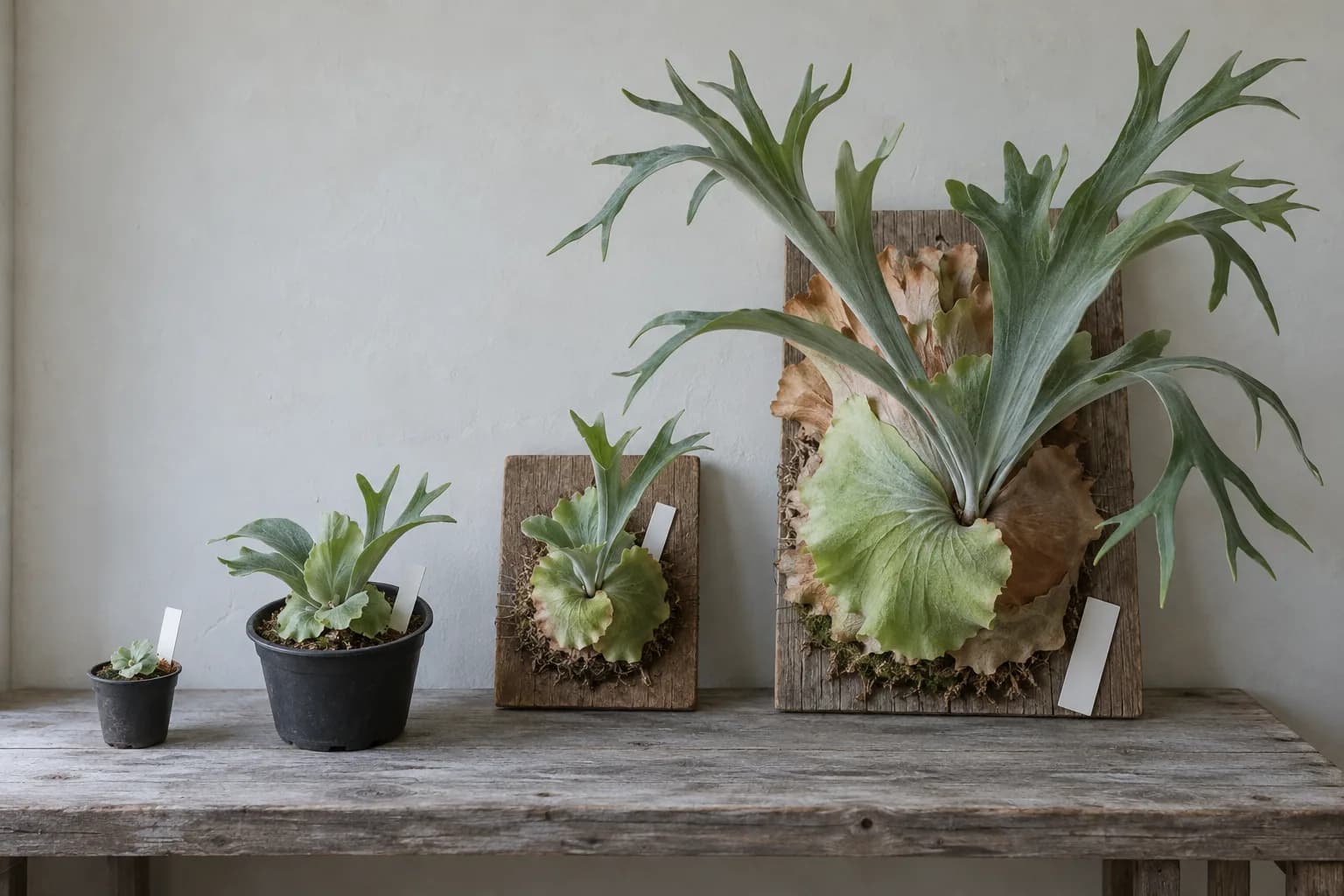
The listing is the first piece of data a seller gives you
A staghorn fern (Platycerium) listing can pack six terms into one line: dwarf willinckii, pup, 3-inch, mounted, mother-plant expression, semi-mature. Each word describes one aspect of the plant: where it came from, how far it has grown, what form it is in now, and whether the lineage can be trusted. Read the terms, and you know what to ask the seller. You also know whether two listings at the same price are actually the same thing.
Group one: where it came from
Pup, sporeling, mixed sowing, tissue culture. This group decides whether the mother plant's form is reproduced at all, and it is where the price gap is widest.
What each method actually means is in pups, sporelings and tissue culture; mixed sowings and "selected" individuals are covered in what to do with a mixed sporeling.
Two things to take from a listing. A pup marked "established" or "mounted for X months" travels far better than one just cut. And Japanese sellers habitually write TC (tissue culture) or OC (a division of a named plant, which is not tissue culture); Taiwanese listings often say nothing, so ask.
Group two: how far it has grown
Seedling or small plant. Usually still in a pot, shield frond smaller than a palm.
Semi-mature. Several complete shield fronds, fertile fronds starting to appear, the habit already visible, but not yet at adult size or crown form. Taiwanese shops use this grade constantly, and each shop draws the line in a different place.
Mature plant. Full crown on the shield, fertile fronds fully extended, producing spore or pups.
Mother plant. A mature plant currently supplying pups or spore. A listing that reads mother plant released usually means the seller is parting with a breeding plant.
How size is described
3-inch and 5-inch refer to the pot diameter, not the plant. In the same 3-inch pot, a P. bifurcatum seedling and a dwarf P. willinckii seedling can differ in body size by a factor of two. The useful numbers are shield diameter, fertile frond length, and the width and height of the board. Some mounted listings also give weight including board; that is so you can size the hook and the wall fixing.
Group three: what form it is in now
Potted. Still in a pot of medium; you will mount it yourself.
Mounted specimen. Already fixed to a board with roots holding the medium; it can be hung and grown on arrival. The price of a mounted specimen includes the board, the medium and the time spent growing it to an established state after mounting. Ask how long ago it was mounted and whether the shield has begun to press against the board.
Collector specimen. This term has no single definition in Taiwan. Most sellers use it for a plant that is a rare cultivar, has a clearly stated mother-plant expression, and already shows the character of its line. When you see collector specimen, ask for the cultivar name, the propagation method and what the mother plant looks like.
Group four: lineage
Cultivar names are mostly trade names rather than registered ones, so the source matters more than the name. A listing that claims clear lineage but cannot produce a mother-plant photo is one to hold off on.
Faced with an unfamiliar name, work through it in three steps — name, then source (which mother plant, which generation, which cross), then photographs to compare — rather than memorising the name alone. A pup is a copy and never earns a new name; "selected" only means the seller sorted by appearance, not that the form is fixed.
How to read the tag itself, and why imported plants often carry two, is in reading a plant tag; on names and authenticity see buying a named cultivar without getting burned.
After reading the listing, five questions for the seller
One: is it a pup, a sporeling or tissue culture? Two: what does the mother plant look like, and may I see a photo? Three: is it a seedling, semi-mature or mature, and how long has it been grown? Four: is it mounted, for how long, and have the roots taken hold? Five: is the size a pot diameter or a shield diameter? When all five are answered clearly, then talk about price.
The three categories on the LDS shop
The LDS shop uses three categories: mounted specimen, collector specimen and sporeling. Every listing states the propagation method and the mother-plant expression.
If a term is unclear, check the glossary first, then ask us. Not mass-produced. Cultivated. The first step of cultivation is writing the label clearly.
FAQ
What is the difference between a mounted specimen and a collector specimen?
Mounted specimen describes form: already fixed to a board, roots holding the medium, ready to hang. Collector specimen describes grade: a hand-selected plant whose cultivar or mother-plant expression stands out. One plant can be both; the two terms answer different questions.
Which is easier to grow, a sporeling or a pup?
A sporeling grew its own roots; it is slow but steady and a good first plant. A freshly separated pup has few roots and must take hold again, which makes it harder, though a pup mounted and established for months is fine. The real difference is origin: a pup copies the mother, a sporeling varies.
What does semi-mature mean, and how big is that?
Semi-mature is the stage with several complete shield fronds, fertile fronds beginning to show, and the habit visible, but not yet at adult size or crown form. Taiwanese shops use the grade often, and each draws the line differently, so ask for the shield diameter and how long the plant has been grown.
What do seed-grown, tissue culture and OC mean?
Seed-grown, in this hobby, means a sporeling raised from spore. Tissue culture, or TC, is a plantlet multiplied from a growing point in the lab, uniform in expression. OC is a Japanese term for a division of the named plant, that is a pup, not tissue culture. The three are valued differently; if a listing omits the method, ask.
A listing says good mother-plant expression. What does that mean?
It means the mature plant that supplied the pup or spore has a strong frond shape, habit, silver finish and spiked crown. A pup copies that expression; a sporeling varies from it. When you see the phrase, ask for a photo of the mother. If none is available, the phrase is only an adjective.
Listings mention "cloud fronds" or a "sugar-frosted" look. Are those cultivars?
No. They are sellers' descriptive slang, neither botanical terms nor separate cultivars, and usually mean a thick coat of white hair that looks like frosting, with fertile fronds that are broad, short and blunt-tipped. Different sellers use different words for what may be the same look, so judge the photos directly by how thick the coat is and how wide the fronds are. Sporelings from one sowing still segregate, so a mother-plant photo is a reference, not a promise.
What does "mutate sporelings" mean on a listing?
"Sporelings" are plants grown from spores, not pups and not tissue culture. "Mutate" signals an unusual, variant frond form: either the mother plant is itself a variant, or this batch has come out looking different from the mother. Sporelings segregate anyway, and a "mutate" label makes them even less predictable, so read it as "the bloodline is clear, the adult form is not" rather than "same as the mother". Listings often put the mother plant's photo first; judge the plant on sale by its own photos further down: how many fronds it has, how wide the crown is, whether the roots have gripped the board, and how long it has been mounted.
Related species