Published · Updated
Does a Staghorn Fern Need Sun? Full Sun, Part Shade, Grow Lights
Yes, more light than most people think, but Taiwan's midday summer sun is too strong for most species. Light is what builds the silver finish and the frond shape; summer and winter need different shade; windows and grow lights indoors. Ends with a link to the full light-tolerance table for all 18 species.
First, the answer: yes to light, no to Taiwan's midday summer sun
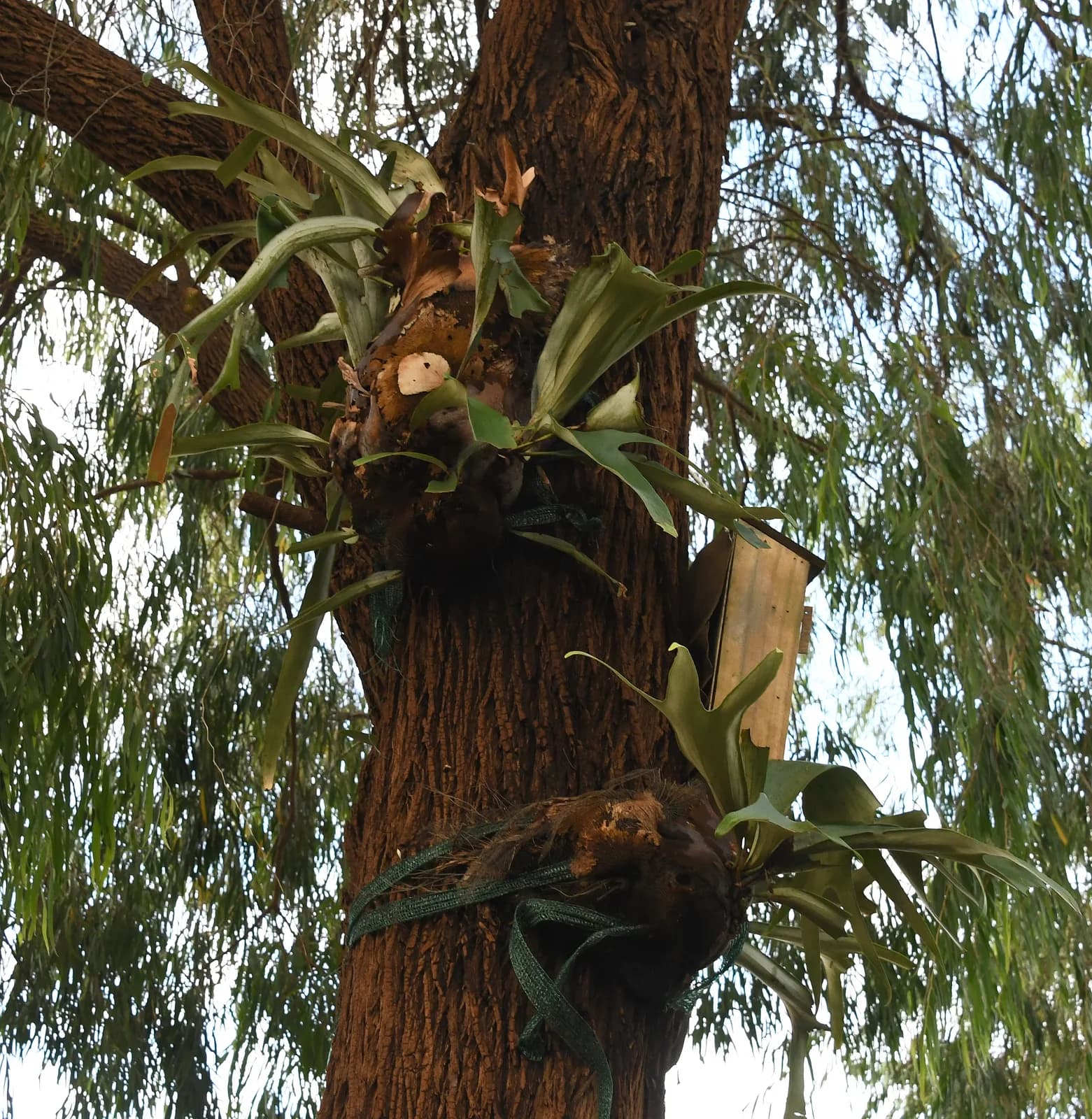
Staghorn ferns are epiphytes. In the wild they sit in the middle to upper trunk, where light is filtered by the canopy but stays bright all day. So the answer is yes, a staghorn fern wants sun, and more of it than most people think; but the direct sun of a Taiwanese summer noon is too strong for most species. The real question is never whether to give sun. It is which species, which season, and how much shade.
Light builds the silver finish and the frond shape
The silver on a fertile frond is a coat of stellate hairs, the plant's own sunscreen. More light means thicker, whiter hair. Too little light and new fronds come in green, thin, stretched and drooping, with fewer forks. Half the collector value of Platycerium veitchii, P. willinckii and P. ridleyi lies in the silver finish and the frond shape, and both are set by light. A frond that has already gone green will not turn silver again; only the next frond recovers, so judge any change in light by the next frond, not the current one. Shields respond the same way: in good light they are full and round with deeply cut tops; in poor light they lie flat and lobe shallowly.
Shaping the plant with the direction of light
Light also shapes the direction a plant grows. Staghorn ferns are phototropic: fertile fronds lean toward the light source. Light from above keeps fronds upright; light from the front pulls them forward. Diffuse light spreads fronds evenly; a single strong point of light draws them together into a denser cluster. Too little light and a plant stretches, with fronds elongating and drooping; too much and fronds scorch. As a rule, the stronger and longer the light, the shorter, more upright and more compact the plant becomes. Rather than chasing a lux number, read how the plant responds and adjust from there.
The setting decides how tall the crown grows
Crown height comes down to the setting more than to the cultivar. Several growers report that a plant raised under stable, climate-controlled grow lights indoors tends to build a shorter, stockier crown than the same plant would in a greenhouse — light intensity, airflow and the day-night swing are all gentler indoors, and a lower crown does not mean the plant is unhealthy. The crown mostly forms in autumn, so if you are moving a plant to a new setting, finish the adjustment over summer so it is ready for that autumn flush. When buying from photos, ask not only about the cultivar and propagation method but also what environment the plant was grown in — the same cultivar can look very different raised in a greenhouse versus under an indoor light rack, and crown-forward species such as P. veitchii show this most clearly. Raise light levels gradually, starting with shade and increasing step by step, to avoid scorch.
Summer and winter are different problems
In a Taiwanese summer the noon sun is intense and the board itself heats up, so most species need shade. Most sources suggest roughly 50% shade cloth outdoors, about 50–70% for heat-sensitive and understorey species, and less for sun-lovers. In winter the sun sits low, the light is weak and the days are short, and most species can take near-full sun; the summer shade cloth comes down. Leaving one piece of cloth up all year is how a plant is right in summer, dim in winter, and quietly loses its silver. For growers in temperate climates the same logic holds indoors: a south window that scorches in July is often not enough in January. Read the plant, not the numbers: scorched frond tips and bleached shields mean too much light; stretched, drooping fronds and silver turning green mean too little.
Indoors: windows and grow lights
South- and east-facing windows are the best positions. An east window gives direct sun in the morning and filtered light in the afternoon, which suits most species. A west window needs a sheer curtain on summer afternoons. A north window is not enough for most species. Light falls off fast beyond a metre from the glass, so anything further back should have a lamp. A full-spectrum LED is enough, for about 10–12 hours a day. Distance depends on the kind of lamp: a panel or tube sits at roughly 30–40 cm, while a spotlight bulb with a reflector concentrates its light and belongs at about 50–150 cm; too close and the fronds twist and the growing point can be damaged. When someone quotes a distance, ask what lamp they use. Either way, a fan under the lamp matters as much as it does outdoors. High-light species such as veitchii and willinckii almost always need a lamp indoors or the silver never develops. A room with no window can grow staghorn ferns under lamps alone, but choose the medium or shade-leaning species; high-light species rarely hold their shape on lamps only. For seedlings, see seedling and pot care. More LED beads or higher wattage does not mean better results: spectrum design, heat dissipation and driver efficiency matter as much, and the real test is how the plant actually grows. After changing a lamp or its position, watch the frond direction for a month or two before fine-tuning.
For how the species themselves rank, see the light tolerance table for all 18 species.
FAQ
Can I keep a staghorn fern indoors, even in a room with no window?
Indoors, yes: a south- or east-facing window is best, and anything more than a metre from the glass should have a grow light. A windowless room works on lamps alone; most sources land at a full-spectrum LED about 30–40 cm away for roughly 10–12 hours a day, with a fan. Choose medium or shade-leaning species, though; high-light species such as veitchii and willinckii rarely build silver or upright fronds on lamps alone.
Why has my silver staghorn fern turned green?
Not enough light. The silver is a coat of stellate hairs that only grows dense under strong light; after a while in a dim room, new fronds emerge green, thin, stretched and drooping. Move the plant to a brighter position in stages or add a grow light. New fronds will come in silver again, but fronds that have already gone green will not change, so judge by the next frond.
Can a staghorn fern be left out in the rain on a balcony?
A short shower is fine for most species, and rainwater suits the medium. Three cautions: during days of continuous rain the mount never dries, so move it under cover; after rain, air must move over the crown so it dries within a few hours; and a summer thunderstorm followed by hard sun leaves a wet, hot board, which is when trouble starts. Species that fear stagnant damp, such as ridleyi and madagascariense, are best kept under a permanent overhang.
Can staghorn ferns take direct sun? Will they burn?
Yes, and they want more light than most people expect; it is Taiwan's midday summer sun that is too strong for most species. Outdoors in summer, shade roughly 50%, about 50–70% for heat-sensitive and understorey species, and a little less for light-tolerant willinckii and bifurcatum; in winter the light is weak and most species can take close to full sun. Too much light shows as scorched fertile-frond tips and bleached shields. When moving a plant somewhere brighter, start in shade and raise the light gradually over a week or two. The table linked at the end ranks each species' sun tolerance.
Should I cut off sunburnt fronds?
No. Sunburn is damage that has already happened; it does not spread like a disease, the burnt frond can still photosynthesise and helps the plant recover, and it will be shed with the old fronds in time. The grey-white marks will not fade. Deal with the cause instead: light that is too strong, or air and moss so dry that the fronds cannot cool down. Fix the shade and humidity first, or new fronds will burn too. When moving a plant from indoors to outdoors, even a short spell of midday sun can leave grey-white marks, so start with half-day light and avoid noon.
Related species