Published
Three Problems When Dividing Pups: Few Roots, Twin Crowns, a Blackening Mother
Dividing pups does not always go to plan: a pup with no shield and few roots needs a moss ball first, a twin crown needs watching before you act, and a mother's blackening growing point needs a read on how much green remains. Three problems, and how to work through each.
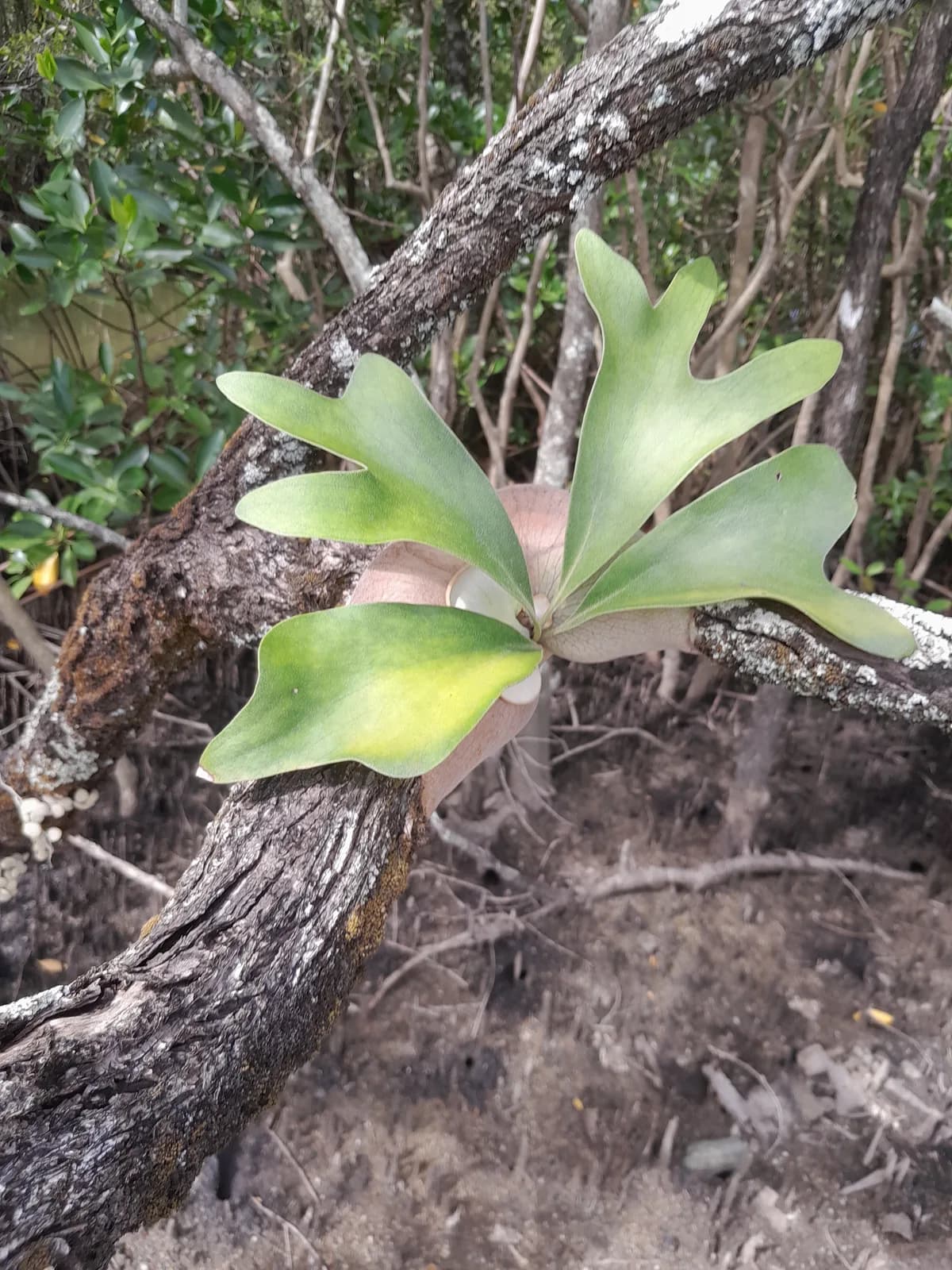
A pup does not always develop the way you would hope: no shield and barely any roots, two buds that might or might not be a genuine twin crown, or a mother's growing point turning black after her pups come off. How to read and handle each of these three cases follows below. Timing is covered in When Is a Staghorn Fern Pup Ready to Divide? and technique in How to Divide a Staghorn Fern Pup.
A pup with no shield and few roots: moss-ball it first
Some pups come off before they have grown a shield frond of their own, with only a few roots, so the growing point hangs unsupported behind them and wobbles at the slightest touch. Mounted straight onto a board like that, they often snap off or fall away entirely. The safer route is to wrap them into a moss ball first: pack sphagnum behind and around the growing point, then build up alternating layers of moss and an airy material such as bark or tree-fern fibre, with a little fertiliser worked in, and bind it with several turns of cotton thread that avoid the growing point and any new scales. Trim the moss round, set the pup growing-point-up, and grow it lying flat rather than hanging it. Once the shield has filled in and roots have filled the ball, cut the thread and mount it properly. A tiny pup that has already dropped off on its own, with almost no roots, can simply go into a small propagation box of sphagnum to grow roots on its own.
Twin crowns and mystery buds
Sometimes two buds appear tightly side by side near the growing point — a twin crown. It isn't a disease, but confirm it first: each bud needs its own growing point and its own fronds, not just fronds from one bud crossing over each other, so watch for a round or two of growth before acting. Option one: score the join between them with a clean blade without separating them, let each side grow its own roots for about a month, then divide and mount as usual. Option two: keep the main bud and scrape or pinch off the smaller one, suited to a bud too small or under-rooted to survive on its own.
For an unidentified side bud, the rule is simple: leave alone anything above and aligned with the main growing point. Anything to the side or below can be removed outright, or watched in a closed, humid box (indoors, under 32°C) — keep it only once it grows its own growing point. A pup worth dividing needs its own growing point, its own fronds and enough roots. Either way, avoid the height of summer and let the cut dry for a few days before resuming normal watering.
When the mother's bud is half black
If a mother plant's growing point is black on one side and still green on the other, don't write it off yet. As long as green tissue remains and new fronds keep coming, the plant is alive. This shows up most often in species that pup heavily — the more pups crowding a mother, the more strain on her, so new fronds come in smaller and the bud loses its sheen. The order to work in: check the growing point first; then remove the pups and mount them separately, clearing away any blackened, rotten tissue and old medium from the mother at the same time; then move her out of direct sun — an hour or two of full sun in summer is enough to scorch a bud, so keep her in filtered light through the hottest months and add sun back gradually in autumn; and for the two weeks after removing pups, water less and keep the light filtered. Don't discard a struggling mother too quickly, and don't reach for heavy watering or fertiliser at this stage. P. willinckii is a common example of a heavy pupper; if the blackening spreads into the fronds themselves, see frond diagnosis.
FAQ
The pup I removed has no shield frond and almost no roots. What should I do?
Do not mount it straight away; it is likely to snap off or fall away. Wrap it into a moss ball instead: pack sphagnum behind and around the growing point, build up alternating layers with an airy material such as bark, bind it with cotton thread that avoids the growing point and new scales, and grow it lying flat. Once the shield has filled in and roots fill the ball, cut the thread and mount it properly.
My pup grew two crowns close together. Is that a genuine twin crown or a problem?
Watch for a round or two of growth first to confirm each bud has its own growing point and its own fronds. One option is to score the join between them with a clean blade, let each side root for about a month, then divide and mount as usual. The other is to keep the main bud and scrape or pinch off the smaller one, suited to a bud too small or under-rooted to survive alone.
The mother plant's growing point turned black after I removed her pups. Can she still recover?
As long as green tissue remains and new fronds keep coming, she is still alive; there is no need to write her off. Check the growing point first, remove the pups and mount them separately while clearing away blackened tissue and old medium, move her out of direct sun, and for the two weeks after division water less and keep the light filtered rather than reaching for heavy watering or fertiliser.
Related species