Published · Updated
When Is a Staghorn Fern Pup Ready to Divide?
A pup is ready when it has its own shield frond, two or three fronds and roots of its own; the season is read from night temperatures, not the calendar. The three conditions, Taiwan's best window from late spring to early autumn, which species never pup, and how a division differs from a sporeling in mother-plant expression.
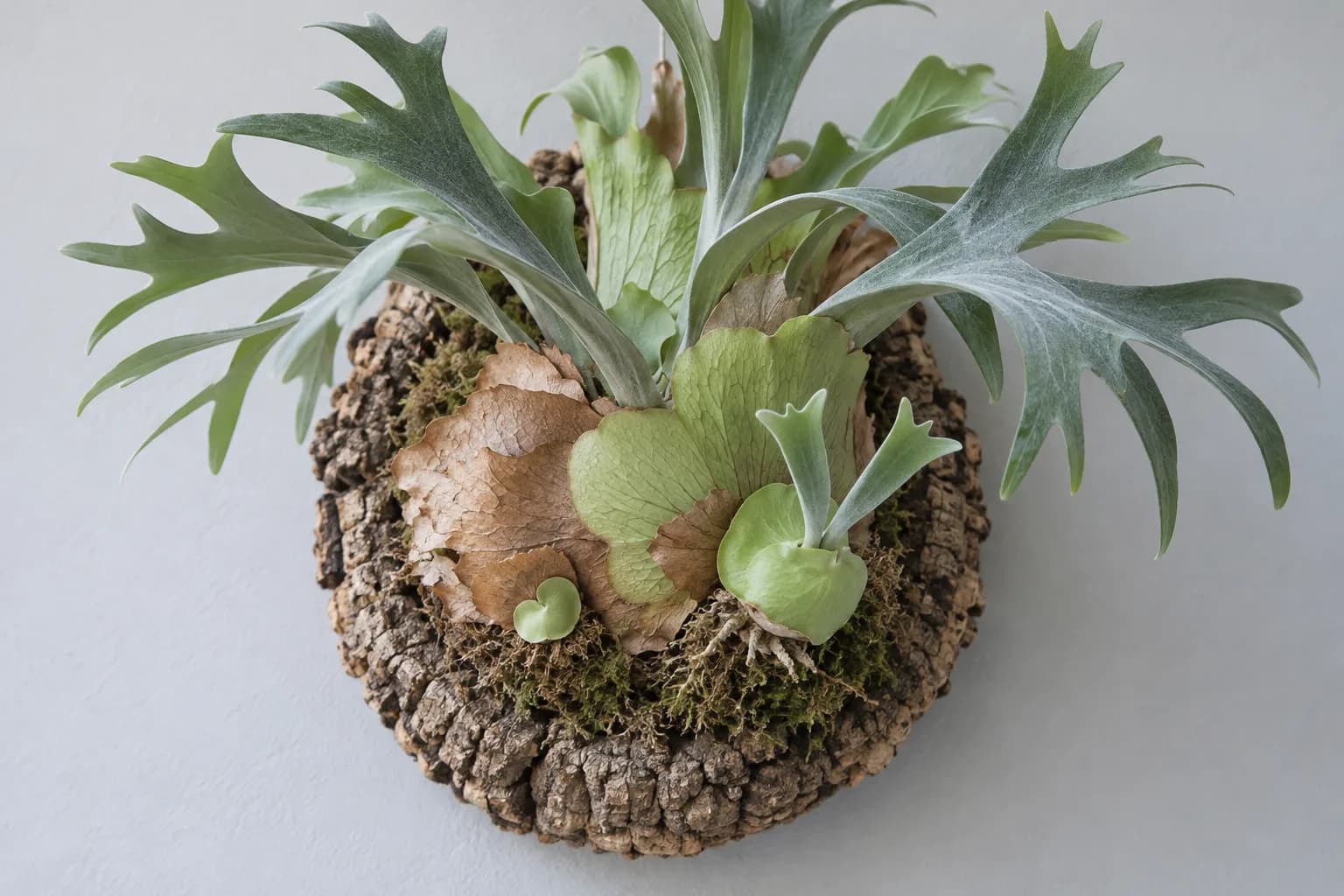
First question: do you need to divide at all
A pup left in place becomes a clump. A three- to five-year colony of P. bifurcatum with stacked shield fronds has a presence no rare species can match. There are usually three reasons to divide: the mother plant is being crowded and weakened, you want the same clone on a second board, or you want a division you can pass on. Without one of those, leaving the pup is often the better display. Read on once you have decided to divide.
Where pups come from
A pup is an extension of the mother's root system, not something that appears from nothing. Once a mounted plant matures, a main root pushes out of the medium and meets open air, and a new pup buds at that contact point; that root keeps feeding the pup from the mother, which is why a pup grows faster than a sporeling starting from spore. A shallow pot or open basket, where roots get light from every side, tends to trigger pups faster than a dense, thick board.
A pup that has just formed carries only a single growing point and no fronds yet, and is easily buried by the mother's shield frond expanding outward — with no frond of its own to push back, a buried pup stops growing and can die. Let it grow before separating it, or wedge a thin tool such as aluminium wire or a toothpick into the medium to pin the shield down and clear space for the pup.
The small plant beside it has gone dark — is it sick?
Usually not. A small plant appearing beside the main one is a pup, and it is normal for it to have differently shaped fronds and no complete shield or fertile fronds yet. Dark colouring and a blackened base most often mean the mother's fronds are pressing on it, so it has been short of light and air for a long time.
Judge by the growing point. If it is still producing new fronds and the bud is firm, keep watching and improve light and airflow. Only if the bud has gone soft and comes away at a gentle pull is it a failed pup, and it should be removed so it does not affect the buds next to it.
When to divide: read the pup, not the calendar
Three conditions must all be true: the pup has grown its own shield frond that has begun to wrap its base; it carries at least two or three fronds, ideally including one fertile frond; and it has roots of its own gripping the moss. All three together usually means the mother has been mounted for a year or more. Time the cut for when the mother's new shield frond is unfurling, and the gap heals without a scar.
Seasonally: in Taiwan, late spring to early autumn, once nights hold at roughly 18°C or above, gives the best results — avoid the weeks around a cold snap. Midsummer division is possible but needs faultless airflow for two weeks after. Early autumn is also ideal, once the muggy heat has broken and new roots still have time to take hold before the next cold snap. A pup forced off before it meets the standard rarely survives a month.
Which species do not pup
Single-crown species cannot be divided. P. ridleyi is universally held not to pup; P. superbum, P. grande and P. wandae are generally treated as single-crowned, and most sources list P. wallichii the same way. For P. andinum and P. quadridichotomum the record is split, with some guides calling them single-bud and some growers recording pups. Almost every plant of these species on the market is a sporeling or tissue culture, so ask the seller how it was propagated. Species that do pup include P. bifurcatum, P. hillii, P. willinckii, P. coronarium, P. elephantotis, P. madagascariense, P. veitchii, P. stemaria and P. alcicorne.
Division and sporeling: two routes to mother-plant expression
A divided pup is a copy of the mother, and the mother-plant expression comes across intact: frond shape, habit, silver finish, the spiked crown on the shield. That is why division is the most reliable way to preserve a cultivar, and why a named clone's value travels along it. A sporeling is the mother's offspring. Every one expresses differently, you cannot know what it will become until it is grown, and yet every new selection appears this way. They are two different things. Buying a pup, look at the mother. Buying a sporeling, ask which plant the spores came from. Raised from a sporeling is where both routes begin, for every staghorn fern (Platycerium).
How to make the cut, and the three problems that most often come up when dividing, are covered in two companion guides: How to Divide a Staghorn Fern Pup and Three Problems When Dividing Pups.
FAQ
When is a staghorn fern pup big enough to separate?
When all three are true: it has its own shield frond that has begun to wrap its base, it carries at least two or three fronds (ideally one fertile), and it has roots of its own gripping the moss. That usually means a year or more after the mother was mounted. In Taiwan, late spring to early autumn with nights around 18 °C or above is the safest window.
Which Platycerium species do not produce pups?
Ridleyi is universally held not to pup; superbum, grande and wandae are generally treated as single-crowned, and most sources list wallichii the same way. For andinum and quadridichotomum the record is split. Plants of these species are almost always sporelings or tissue culture, so ask how they were propagated. Bifurcatum, willinckii, coronarium, elephantotis, madagascariense and hillii all pup.
What is the difference between a pup and a sporeling?
A pup is a copy of the mother, so the mother-plant expression carries over intact; it is the most reliable way to preserve a cultivar. A sporeling is the mother's offspring: every one expresses differently and you cannot know its adult form until it is grown, but new selections come from here. Buying a pup, look at the mother; buying a sporeling, ask where the spores came from.
A pup is growing behind an old shield, or right where the mother's new shield needs to spread. Should I remove it?
Usually, yes. A pup hidden behind old shields gets little light and tends to stretch and pale; one sitting above or in front of the mother blocks the path of its new shield, which then grows crooked, lifts, or fails to grip the board, and both plants lose their shape. Remove it once the three conditions above are met (its own shield wrapping its base, two or three fronds, its own roots gripping the moss). Afterwards root it in a pot of moss, growing point up, in bright light out of direct sun; two or three months with no visible change is normal, and it can be mounted once its shields have filled out and the roots have taken over the moss. A pup on the outside that blocks neither light nor the mother can stay to build a clump.
Related species