Published
When and How to Divide Staghorn Fern Pups: Timing, Tools and the First Two Weeks
A pup is ready when it has its own shield frond, two or three fronds and roots of its own; the season is read from night temperatures, not the calendar. How to make a clean cut, why the pup gets no soaking for the first three days, what light and air to give in the first two weeks, which species never pup, and how a division differs from a sporeling in mother-plant expression.
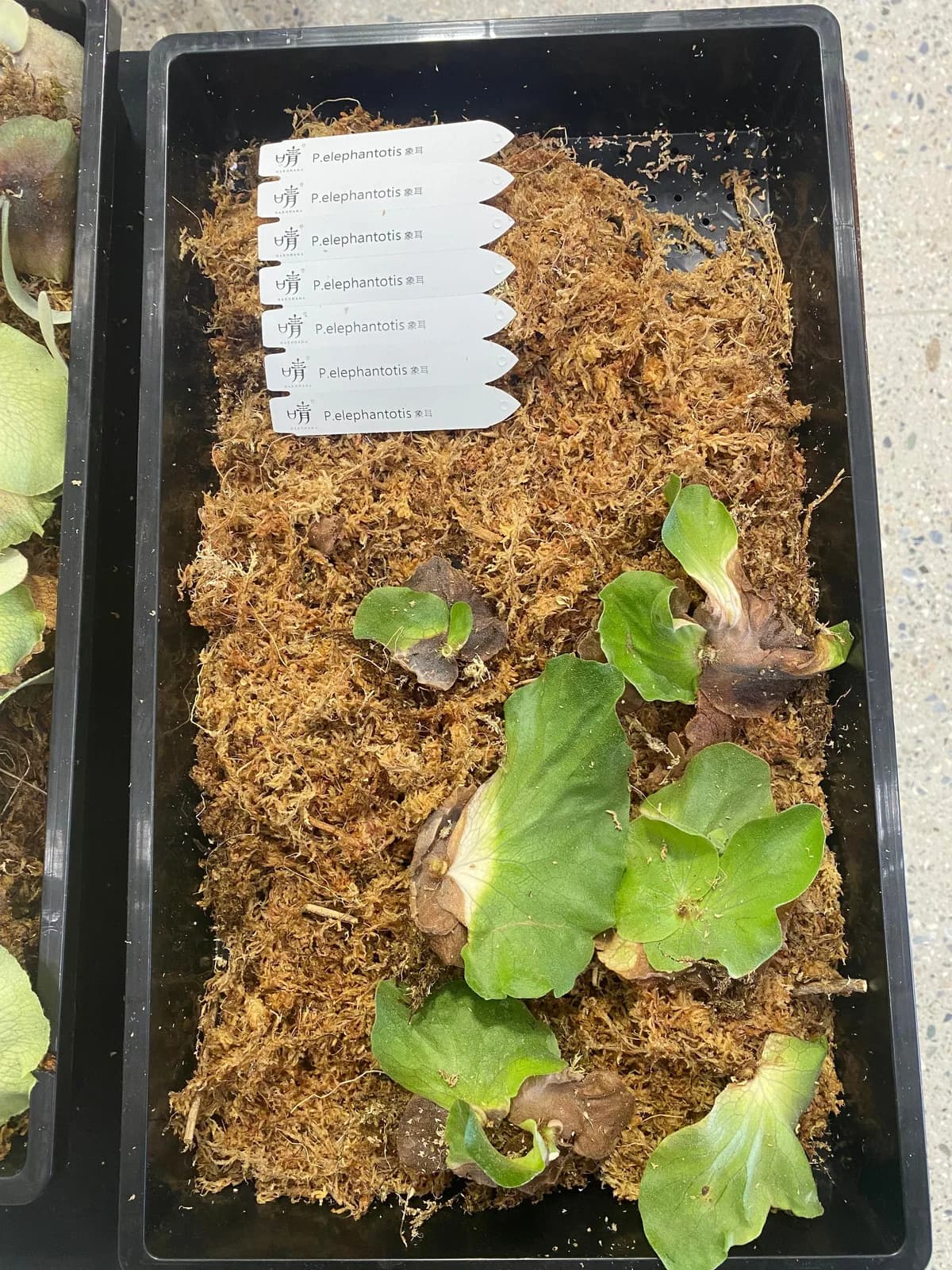
First question: do you need to divide at all
A pup left in place becomes a clump. A three- to five-year colony of P. bifurcatum with stacked shield fronds has a presence no rare species can match. There are usually three reasons to divide: the mother plant is being crowded and weakened, you want the same clone on a second board, or you want a division you can pass on. Without one of those, leaving the pup is often the better display. Read on once you have decided to divide.
When to divide: read the pup, not the calendar
Three conditions must all be true. First, the pup has grown its own shield frond and that shield has begun to wrap its own base. The shield is how a pup takes in water on its own; without it the pup has no mouth. Second, it carries at least two or three fronds, ideally including one fertile frond, because producing a fertile frond means it has energy to spare. Third, lift the medium and confirm it has roots of its own gripping the moss. All three together usually means the mother has been mounted for a year or more.
Seasonally, late spring to early autumn gives the best results in Taiwan, once nights hold at roughly 18 °C or above and roots are active. Avoid the weeks around a cold snap. Midsummer division is possible, but the two weeks of aftercare need faultless airflow. A pup forced off before it meets the standard rarely survives a month.
Which species do not pup
Single-crown species cannot be divided. P. ridleyi is universally held not to pup; P. superbum, P. grande and P. wandae are generally treated as single-crowned, and most sources list P. wallichii the same way. For P. andinum and P. quadridichotomum the record is split, with some guides calling them single-bud and some growers recording pups. Almost every plant of these species on the market is a sporeling or tissue culture, so ask the seller how it was propagated. Species that do pup include P. bifurcatum, P. hillii, P. willinckii, P. coronarium, P. elephantotis, P. madagascariense, P. veitchii, P. stemaria and P. alcicorne.
Tools
A sharp blade (a craft knife, grafting knife or thin paring knife), wiped with alcohol or passed through a flame. A small handful of fresh sphagnum, soaked and wrung out to barely damp. A small board or cork slab. Fishing line or cotton thread. Cinnamon or charcoal powder for the cut is optional. Do not tear a pup off with blunt scissors; a ragged wound rots far more readily than a clean cut, on the pup and on the mother alike.
How to divide
Find where the pup joins the mother, usually a short rhizome buried between old shield fronds and moss. Part the medium with your fingers until you can see where the pup's own roots run. Cut from the mother's side, taking a small piece of old tissue and the roots along with the pup. Better to take a little too much of the mother's old shield than to nick the pup's growing point. One decisive stroke, not a sawing motion. Most sources suggest letting both cuts dry in the shade for a few hours to a day before doing anything else. The wound on the mother needs no dressing, only airflow.
Mounting the pup: wrap the roots in barely damp sphagnum, set it against the board with the growing point upright and tilted slightly forward, and tie it on. Do not pack the moss tight, and do not pile it so high that it covers the shield.
The first two weeks
Days one to three. No soaking. The moss went on damp and carries the pup through these days. Mist the air around it to hold humidity, but not the growing point. Bright filtered light, never direct sun. Air moving, but gently.
Days four to seven. Give the first light watering only once the moss surface has dried, from the side, without soaking the board. Watch the shield: slight puckering is normal; a shield collapsing flat means the roots have not taken or the wound has failed.
Week two. Hold the same filtered light, gentle air and barely damp moss. Most sources advise no feeding for the first month. A shield that tightens again, or a new root tip at the edge, means the pup has taken. Over the next week or two move it gradually back toward its usual light. Full establishment, with a new frond growing, usually takes two to three months.
Division and sporeling: two routes to mother-plant expression
A divided pup is a copy of the mother, and the mother-plant expression comes across intact: frond shape, habit, silver finish, the spiked crown on the shield. That is why division is the most reliable way to preserve a cultivar, and why a named clone's value travels along it. A sporeling is the mother's offspring. Every one expresses differently, you cannot know what it will become until it is grown, and yet every new selection appears this way. They are two different things. Buying a pup, look at the mother. Buying a sporeling, ask which plant the spores came from. Raised from a sporeling is where both routes begin, for every staghorn fern.
FAQ
When is a staghorn fern pup big enough to separate?
When all three are true: it has its own shield frond that has begun to wrap its base, it carries at least two or three fronds (ideally one fertile), and it has roots of its own gripping the moss. That usually means a year or more after the mother was mounted. In Taiwan, late spring to early autumn with nights around 18 °C or above is the safest window.
Will the pup die after I remove it? What is the success rate?
If it met the three conditions, the cut was clean, it got no soaking for the first three days and sat in filtered light with gentle air, most survive. The three main killers are forcing off a pup too small, nicking the growing point, and soaking plus direct sun straight after division. We do not quote a percentage; species and conditions vary too much.
Which Platycerium species do not produce pups?
Ridleyi is universally held not to pup; superbum, grande and wandae are generally treated as single-crowned, and most sources list wallichii the same way. For andinum and quadridichotomum the record is split. Plants of these species are almost always sporelings or tissue culture, so ask how they were propagated. Bifurcatum, willinckii, coronarium, elephantotis, madagascariense and hillii all pup.
Should I water a pup right after dividing it?
Do not soak it. The sphagnum it was mounted in is already damp and carries it through the first three days; mist the air around it, not the growing point. From day four to seven, give a light watering from the side only once the moss surface has dried. Most sources advise no feeding for the first month, and the pup is established once a new frond moves, usually after two to three months.
What is the difference between a pup and a sporeling?
A pup is a copy of the mother, so the mother-plant expression carries over intact; it is the most reliable way to preserve a cultivar. A sporeling is the mother's offspring: every one expresses differently and you cannot know its adult form until it is grown, but new selections come from here. Buying a pup, look at the mother; buying a sporeling, ask where the spores came from.
Related species