Published · Updated
How Often to Change Sphagnum on a Staghorn Fern: by Condition, Not by Calendar
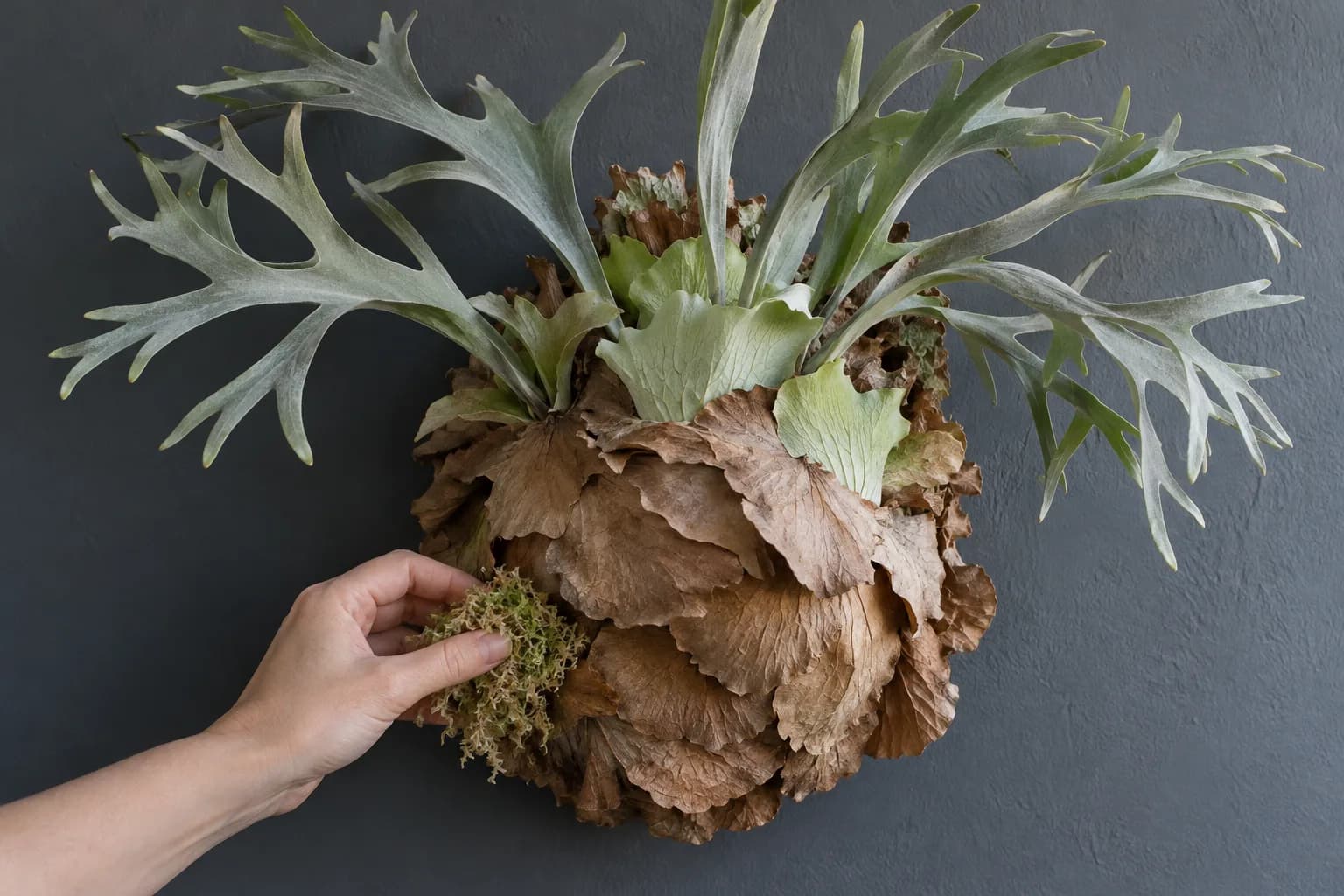
Sphagnum is replaced by condition, not on a schedule: sour or foul smell, broken down to mud, water running off or never drying, white crystals on the board. But most of the time there is nothing to dismantle. The shield fronds wrap the board and become the medium; adding moss or joining a larger board is enough.
First, the honest answer: by condition, not by calendar
"How often should I replace the sphagnum" belongs to the same family as "how often should I water", and the answer is the same: there is no fixed interval. Most sources say sphagnum begins to break down in roughly one to three years, but the same batch lasts very differently on a breezy balcony and in a humid, still room, and tap water and rainwater build up salts at different rates. What is worth learning is how to read the medium, and one principle: most of the time you do not need to take the plant apart at all.
How sphagnum ages
Fresh sphagnum is loose, holds several times its weight in water and still lets air through, and it springs back when soaked after drying. Ageing is four things happening at once.
Acidification. Sphagnum is acidic to begin with, becomes more so as it decays, and fertilizer residue adds to it. A sour, musty or rotten-egg smell means the medium is decomposing without oxygen.
Powdering. The fibres break down into fine particles and mud. It stays compressed when pressed and feels like wet clay. Air stops reaching the roots.
Abnormal water behaviour. Two opposite symptoms both count. Bone-dry moss that will not take water during a soak, with water rolling off the surface; or moss that stays wet for days after soaking. The first is fibre repelling water, the second is mud holding it.
Salt build-up. A white crust on the moss or the board is mineral from tap water plus fertilizer salts. Try several plain-water soaks to flush it before deciding anything.
Colour alone is not a sign. All sphagnum darkens with use, and judging by colour leads to unnecessary remounts.
On picking the replacement, see choosing sphagnum.
The shield frond wraps the board: most of the time, do not tear down
This is the central idea of the article. Once a mounted staghorn fern (Platycerium) reaches a certain size, its shield fronds layer over the board, enclose the medium and brown off, and the old shields themselves become the new medium that the roots grow into. The sphagnum inside is no longer the main event. On pupping species such as bifurcatum, willinckii and coronarium, a few years in, the whole face of the board is shield and you cannot reach the moss anyway.
So when you notice the moss has aged, ask first: is the plant healthy? Is each new frond larger than the last? Are the shields renewing normally? If yes to all three, two light interventions are all you need.
Add moss. Tuck fresh sphagnum into the gap between the shield edge and the board, where roots can reach it. For plants whose board is still large enough but whose medium has thinned. If the growing point seems to bulge out from the board and there is a gap between shield and board, the moss behind the shield has usually slumped: push small pinches of sphagnum into the gap from the bottom up, stopping once the shield sits back against the board, and leave green shields uncut. Run the fishing line under the shield and around the board to hold the new moss, never across the face of the shield.
Add a board. When the plant has outgrown its mount, leave it where it is and fix the whole old board onto a larger new one, packing fresh moss into the gaps so the roots can grow across. This is the safest option for any large specimen, and ideal when a P. bifurcatum clump has filled its board: no dividing, no root disturbance.
A board whose face is entirely roots, with the medium nearly gone, is a sign of a mature, healthy plant, not a reason to remount; leave it unless the board itself is rotting or the hardware has failed. Once a plant sits in the right spot, let it stay there: it puts its energy into roots and fronds instead of readjusting. A plant that looks weaker for a while after a move is resettling, not sick, so resist the urge to feed more, water more, or move it again.
So when does a board actually need changing?
Only three situations: the board itself has rotted, the roots have rotted, or you need a larger board and cannot join it to the old one. Everything else that merely looks old does not count. The full criteria, timing, method and aftercare are in when to change a staghorn fern's board.
FAQ
How often should I replace the sphagnum moss on a staghorn fern?
There is no fixed interval. Most sources say sphagnum starts breaking down in roughly one to three years, but airflow, water quality and feeding change that a great deal, so judge by condition: a sour smell, a muddy texture that stays compressed, moss that will not soak in or never dries, a white salt crust. And in most cases you do not remount at all; the shield fronds wrap the board and become the medium, so adding moss or attaching a larger board is enough.
How do I tell that the sphagnum has gone bad?
Four signs. A sour, musty or rotten-egg smell. A texture like wet clay that stays compressed when pressed. Water that rolls off during a soak and will not penetrate, or moss that stays wet for days afterwards. A white crust of salts on the medium or board. Darkening alone does not count, since all sphagnum darkens with use. A salt crust can often be flushed with several plain-water soaks rather than replaced.
Does a staghorn fern that has outgrown its board have to be remounted?
Usually not. If the plant is healthy, each new frond is larger than the last and the shields are renewing normally, fix the whole old board onto a larger new one and pack fresh sphagnum into the gaps so the roots grow across on their own. This attaches rather than remounts, disturbs no roots and removes no shields, and it is the safest option for a large specimen, especially a bifurcatum clump that has filled its board.
The sphagnum has white mouldy spots and water runs straight through. Do I need to remount?
Separate two things first. Scattered white crystals on the surface are usually minerals and fertiliser salts from the water; rinse with a few plain-water soaks and look again. If it is white mould that keeps spreading, soak the whole mount for three to five minutes: if the weight clearly comes back, it had simply dried out too far, so carry on as usual. If it is still light after soaking and the inside is still dry when you part it, the moss has broken down, and taking it apart often shows a hollowed-out medium and blackened roots. Do not try to fix that by adjusting watering. Take it off the board, clear out the rotten roots and the disintegrated old moss, and replace the board too if it has gone soft or mouldy; after remounting, keep it in moving air and water lightly until the roots grip the board again.
The moss has come away from the board, water seems to run straight off, and the fronds are dehydrated and curling. Can it be saved?
First tell thirst from root damage. Dried moss shrinks and pulls away from the board, water runs off through the gap, the core stays dry, and the plant lives in a constant mild drought. Soak the whole plant until the moss is saturated and watch for two or three days: if the fronds firm up again, it was thirst; if nothing changes, the roots are probably damaged, and recovery will take a long time and may not come at all. Judge life by the growing point and the base of the shields: no blackening and a firm base mean there is a chance; a black, soft base that lifts off the board at a gentle pull usually means it is lost. Once it recovers, re-tie it firmly and push moss into the gap until it sits against the board again, and hold off on fertiliser and strong light for a while.
Related species