Published
How Often to Replace Sphagnum Moss and When to Remount a Staghorn Fern: Read the Medium and the Shield Frond
Sphagnum on a staghorn fern is replaced by condition, not by calendar: a sour smell, a slimy or muddy texture, water that will not soak in or never dries, a white salt crust. Most of the time, though, there is no need to tear the plant down. The shield fronds wrap the board and become the new medium, and adding moss or attaching the old board to a larger one is enough. True remounting is for a rotting board, rotting roots, or a bigger mount that cannot be attached; the best season is late spring to early summer while shield fronds are growing. Aftercare for the first two weeks links back to the mounting guide.
First, the honest answer: by condition, not by calendar
"How often should I replace the sphagnum" belongs to the same family as "how often should I water", and the answer is the same: there is no fixed interval. Most sources say sphagnum begins to break down in roughly one to three years, but the same batch lasts very differently on a breezy balcony and in a humid, still room, and tap water and rainwater build up salts at different rates. What is worth learning is how to read the medium, and one principle: most of the time you do not need to take the plant apart at all.
How sphagnum ages
Fresh sphagnum is loose, holds several times its weight in water and still lets air through, and it springs back when soaked after drying. Ageing is four things happening at once.
Acidification. Sphagnum is acidic to begin with, becomes more so as it decays, and fertilizer residue adds to it. A sour, musty or rotten-egg smell means the medium is decomposing without oxygen.
Powdering. The fibres break down into fine particles and mud. It stays compressed when pressed and feels like wet clay. Air stops reaching the roots.
Abnormal water behaviour. Two opposite symptoms both count. Bone-dry moss that will not take water during a soak, with water rolling off the surface; or moss that stays wet for days after soaking. The first is fibre repelling water, the second is mud holding it.
Salt build-up. A white crust on the moss or the board is mineral from tap water plus fertilizer salts. Try several plain-water soaks to flush it before deciding anything.
Colour alone is not a sign. All sphagnum darkens with use, and judging by colour leads to unnecessary remounts.
The shield frond wraps the board: most of the time, do not tear down
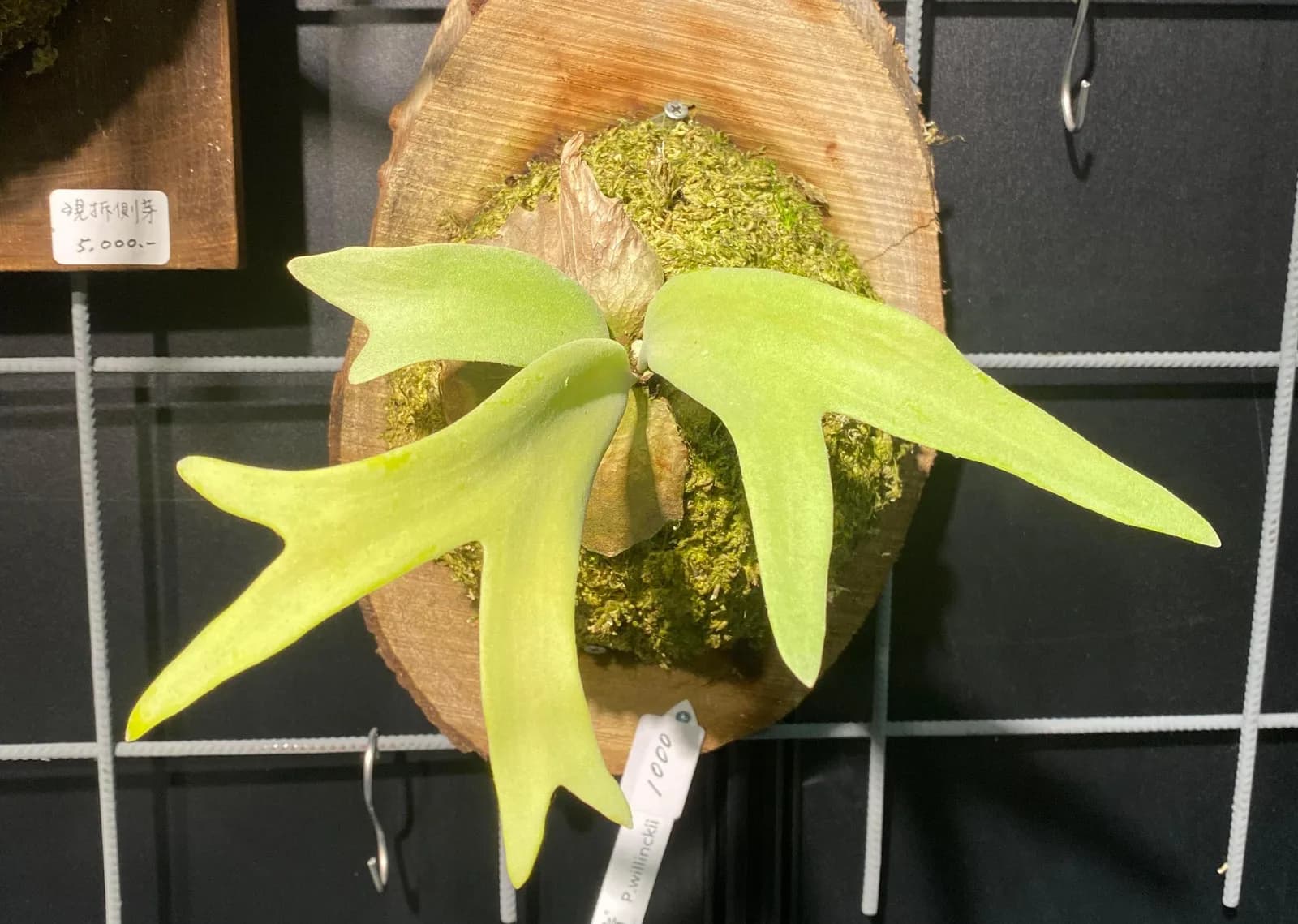
This is the central idea of the article. Once a mounted staghorn fern reaches a certain size, its shield fronds layer over the board, enclose the medium and brown off, and the old shields themselves become the new medium that the roots grow into. The sphagnum inside is no longer the main event. On pupping species such as bifurcatum, willinckii and coronarium, a few years in, the whole face of the board is shield and you cannot reach the moss anyway.
So when you notice the moss has aged, ask first: is the plant healthy? Is each new frond larger than the last? Are the shields renewing normally? If yes to all three, two light interventions are all you need.
Add moss. Tuck fresh sphagnum into the gap between the shield edge and the board, where roots can reach it. For plants whose board is still large enough but whose medium has thinned.
Add a board. When the plant has outgrown its mount, leave it where it is and fix the whole old board onto a larger new one, packing fresh moss into the gaps so the roots can grow across. This is the safest option for any large specimen, and ideal when a P. bifurcatum clump has filled its board: no dividing, no root disturbance.
When remounting really is necessary
The board is rotting. Soft, splitting, growing fungus, hanger pulling loose. This is a structural failure and there is no alternative.
The roots are rotting. Foul smell, persistent waterlogging, fertile fronds that droop and do not recover after a soak, blackening near the growing point. The medium is now the source of disease: open it up, remove rotten roots, and start with new sphagnum. The diagnosis is in frond diagnosis.
A larger board is needed and the old one cannot be attached. An irregular old mount, or a change of material. Attach if you can; tear down only if you cannot.
Species matters. P. coronarium grows tall and heavy, with fertile fronds hanging more than a metre, so the board and hanger must carry the weight; start with a thick board. Non-pupping giants such as P. wandae and P. superbum can barely be moved once their shields wrap the board, and most sources advise leaving them alone after establishment, which means the first board must already be large and thick.
Best season
Late spring to early summer, as growth begins and the plant is producing shield fronds, is best; autumn is second. Avoid the weeks around a cold snap and the hottest part of summer. Some growers note that disturbing the roots while fertile fronds are unfurling drags recovery out badly, sometimes by years, whereas working during shield-frond development finds the roots more settled. Species differ a great deal. Watch your plant, not the calendar.
Three rules if you do it
Do not peel off shield fronds: the brown old shields are part of the plant, and removing them removes its medium. Do not scrape the roots; keep whatever old medium is sound and clear only the smelly, muddy part. Soak new sphagnum before use and pack it loosely, never compressed. The full procedure and tying methods are in the mounting guide.
The two weeks after remounting
Treat it exactly like a freshly mounted plant: filtered light, moving air, medium kept slightly damp rather than soaked, no fertilizer. Do not water daily out of worry. Most plants settle within two weeks, and the first new frond is the sign that the roots have truly reconnected. Details are in the aftercare section of the mounting guide; when to resume feeding is in fertilizing and banana peels.
FAQ
How often should I replace the sphagnum moss on a staghorn fern?
There is no fixed interval. Most sources say sphagnum starts breaking down in roughly one to three years, but airflow, water quality and feeding change that a great deal, so judge by condition: a sour smell, a muddy texture that stays compressed, moss that will not soak in or never dries, a white salt crust. And in most cases you do not remount at all; the shield fronds wrap the board and become the medium, so adding moss or attaching a larger board is enough.
How do I tell that the sphagnum has gone bad?
Four signs. A sour, musty or rotten-egg smell. A texture like wet clay that stays compressed when pressed. Water that rolls off during a soak and will not penetrate, or moss that stays wet for days afterwards. A white crust of salts on the medium or board. Darkening alone does not count, since all sphagnum darkens with use. A salt crust can often be flushed with several plain-water soaks rather than replaced.
Does a staghorn fern that has outgrown its board have to be remounted?
Usually not. If the plant is healthy, each new frond is larger than the last and the shields are renewing normally, fix the whole old board onto a larger new one and pack fresh sphagnum into the gaps so the roots grow across on their own. This attaches rather than remounts, disturbs no roots and removes no shields, and it is the safest option for a large specimen, especially a bifurcatum clump that has filled its board.
When is the best time to remount a staghorn fern?
Late spring to early summer, as growth starts and the plant is producing shield fronds; autumn is second. Avoid the weeks around a cold snap and the hottest part of summer. Some growers note that disturbing the roots while fertile fronds are unfurling drags recovery out badly, whereas the roots are more settled during shield development. For two weeks afterwards treat it as freshly mounted: filtered light, airflow, slightly damp medium, no fertilizer.
Should I remove the brown shield fronds when remounting?
No. The brown old shields are part of the plant: they enclose the medium, grip the board, and the roots grow inside them, so removing them removes medium and roots together. Do not scrape the roots either; keep whatever old medium is sound and clear only the smelly, muddy part. Soak new sphagnum before use and pack it loosely rather than compressing it.
Related species