Published
Do Staghorn Ferns Need Fertilizer: Light Feeding in the Growing Season, When to Stop, and Whether the Banana Peel Trick Works
A staghorn fern does need fertilizer, but very little. As an epiphyte it is used to a trickle of nutrients, not an occasional flood. When to feed: lightly through the spring-to-autumn growing season. When to stop: winter, dormancy, and after mounting or dividing a pup. Slow-release or liquid, how far to dilute, where to place it. And an honest answer on banana peels: the idea has a basis, since shield fronds collect leaf litter anyway, but a raw peel behind the shield moulds and attracts pests, and most sources consider its potassium content overstated.
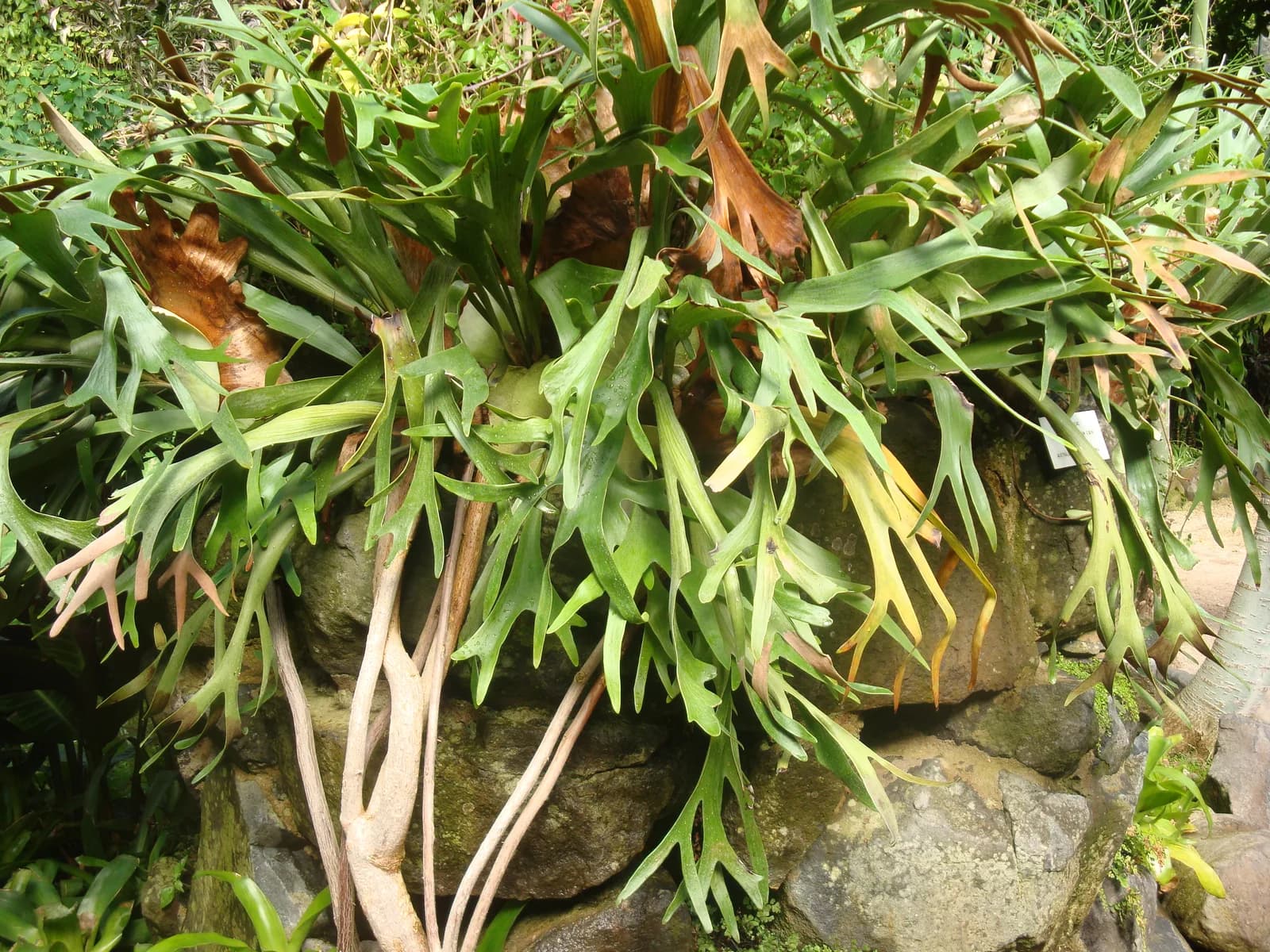
First, the honest answer: yes, but very little
A staghorn fern is an epiphyte. In the wild it grows on bark with no soil, fed by rain, dust and whatever leaf litter its own shield fronds trap. It is used to a little all the time, not a lot occasionally. So it does want fertilizer, but at a dose and frequency well below most houseplants. The common beginner mistake is not forgetting to feed. It is feeding too much.
The shield frond is already collecting
On a mounted plant the shield fronds open upward and wrap the board, and on a wild trunk they catch falling leaves and debris, which slowly break down into humus that the roots grow into. Large species such as P. superbum and P. wandae form a whole nest. This is where the banana peel idea comes from: people watched the plant gather organic matter and decided to help. The instinct is right; the method has problems, covered below.
When to feed: lightly, in the growing season
Spring to autumn is the only time to feed. Most species wake in late spring and peak in autumn; fast, pup-heavy species such as P. bifurcatum and P. willinckii use more than slow ones. Most sources land on liquid feed roughly every 2 to 4 weeks, or a small dose of slow-release once a season. Pick one; do not stack them.
Stop in winter. In the cold the roots take up almost nothing, and unused fertilizer sits in the medium as salt that burns the roots when growth resumes. Leave the plant alone around a cold snap; see winter cold snap care.
Stop in dormancy. The dry-season rest of P. wallichii, P. elephantotis and P. quadridichotomum, and the summer stall of P. superbum in sustained heat, are states in which the plant is not eating. If the fronds are not moving, do not feed.
Do not feed a newly mounted plant or a freshly divided pup. The roots have not gripped the board yet, and fertilizer only irritates damaged tissue. Wait until new roots hold the medium and the first new frond has opened, then start at an even weaker dilution. Most sources suggest waiting at least one to two months. Aftercare for mounting is in the mounting guide and for pups in dividing pups.
What to use: slow-release or very dilute liquid
Liquid feed. A balanced formula, three numbers close together or a general foliage-plant feed, diluted to half the label strength or less; most sources use a quarter to a half. Add it to the soaking water or pour it onto the medium. Keep it off the growing point and off the fronds. Follow every feed with a plain-water soak; do not feed on consecutive waterings.
Slow-release granules. A small amount tucked into the gap between the back of the shield frond and the medium, released a little at each watering. Use less than you think. More does not make the plant grow faster; it only burns roots.
Organic feeds. Fully composted is fine. Uncomposted is not, because it keeps fermenting on the board, generates heat and attracts insects.
Silver-haired species like willinckii can only use fertilizer when they have enough light. Feed a plant in dim light and it produces soft green fronds. Fix the light first; see light and sun exposure.
Do banana peels work?
Honestly: the idea has a basis, and tucking a peel behind the shield is still a poor method.
Where the idea comes from. The shield collects litter anyway, a peel is organic matter, and it contains potassium and a little phosphorus. In theory it breaks down and gets absorbed.
What goes wrong. A whole peel pressed against the back of a shield in a warm, damp spot moulds within days and draws fruit flies and ants, right next to the growing point. The decay is uncontrolled: you have no idea how much is released, or when.
The potassium claim. Most sources consider the potassium content of banana peels overstated, and peels contain almost no nitrogen, the nutrient that actually drives frond growth. A peel cannot replace fertilizer.
If you still want to try. Chop a peel, steep it in water for one to two days, strain out the solids and water with the liquid occasionally as a supplement between feeds. Nothing is left on the board to rot. But a small dose of dilute liquid feed does the same job, and you know exactly how much you gave.
Reading fertilizer burn
Crisp brown frond tips or edges, a white crust on the moss or board, and distorted new fronds are the signs of too much. Flush the mount by soaking in plain water, then halve the dose and lengthen the interval. Browning has several causes; the diagnosis is in frond diagnosis.
Less is safer
A staghorn fern that never gets fed simply grows slowly. One that gets too much can be lost in a single season. A plant raised from a sporeling needs almost nothing extra in its first year; what the breaking-down medium releases is enough. Get light, air and water right first. Fertilizer is the last variable.
FAQ
Do staghorn ferns need fertilizer?
Yes, but very little. As an epiphyte it is used to a steady trickle of nutrients, not an occasional flood. Through the spring-to-autumn growing season give liquid feed diluted to half strength or less roughly every 2 to 4 weeks, or a small dose of slow-release once a season, not both. Stop in winter, in dormancy, and after mounting or dividing. An unfed plant grows slowly; an overfed one can be lost in a season.
Do banana peels really work on a staghorn fern?
The idea has a basis, but tucking a peel behind the shield is a poor method. Shield fronds collect leaf litter anyway, which is why people try to help. A whole peel in that warm, damp spot moulds within days and attracts fruit flies and ants next to the growing point, and most sources consider its potassium overstated while it contains almost no nitrogen. If you must, steep chopped peel in water for a day or two, strain, and use the liquid occasionally. Dilute liquid feed is more controllable.
When should I not fertilize a staghorn fern?
Four times. Winter, when cold roots take up nothing and fertilizer becomes root-burning salt. Dormancy, the dry-season rest of wallichii, elephantotis and quadridichotomum and the summer stall of superbum: if the fronds are not moving, do not feed. Right after mounting, before the roots grip the board. Right after dividing a pup, before the wound heals. For the last two, most sources suggest waiting one to two months, until new roots hold the medium and the first new frond opens, then starting weaker than usual.
What fertilizer should I use on a staghorn fern, and how much should I dilute it?
A balanced or general foliage-plant liquid feed diluted to half the label strength or less; most sources use a quarter to a half. Add it to the soaking water or pour it onto the medium, never onto the growing point or fronds. Slow-release granules go in small amounts between the back of the shield and the medium. Follow each feed with a plain-water soak. Avoid uncomposted organic material, which heats up on the board and attracts insects.
What does fertilizer burn look like on a staghorn fern, and how do I fix it?
Crisp brown frond tips or edges, a white crust on the moss or board, and distorted new fronds. Flush the mount with several plain-water soaks, then halve the dose and lengthen the interval. Brown edges can also come from sun scorch, dry moving air or drought, so read the timing and the position of the damage together; the frond diagnosis guide covers this.
Related species